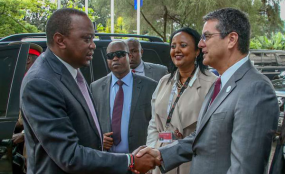
President Uhuru Kenyatta (left), greets World Trade Organisation chief Roberto Azevêdo
As the world’s attention focuses on the 10th Ministerial Conference of the World Trade Organisation (WTO), Africa should be clear on its agenda and what it expects from the assembly.
A lot has been said about Africa hosting this conference at a time when the voice of least developed and emerging economies has been louder than ever before in the Doha Rounds and has charted the course for these negotiations.
The director-general of the World Trade Organisation, Mr Roberto Azevêdo, has pointed out that export promotion remains at the top of the African agenda of deliverables in Nairobi.
Yet the question must be asked whether export promotion, important as it may seem, is Africa’s priority at this point in time.
Better still, who sets the agenda for Africa and her priorities on matters trade?
One of the most contentious issues in integrating Africa’s trade into the multilateral trading system and improving its share in global trade has been agriculture, the traditional bedrock of the continent’s commerce.
Any meaningful deliberations on the continent’s trade must have agriculture as its priority.
The question of farmer subsidies in developed economies remains unresolved.
Without such commitments and action towards reducing and ultimately eliminating these subsidies, market access for African farmers will remain a mirage.
Africa must move beyond market access and demand market entry.
It is hoped that the Trade Facilitation Agreement (TFA) will be ratified in Nairobi.
This is a special agreement for Africa, particularly considering the low intra-Africa trade volumes.
To improve their profiles at the multi-lateral level, African countries must increase their trade with one another, and one of the ways to do so is to have the TFA ratified in Nairobi.
A herculean task this might be, but it would revolutionise intra-Africa trade as it addresses the perennial impediments to trade, including border measures, customs procedures, non-tariff measures, simplification of trade procedures and documentation, physical infrastructure, and security concerns.
That the specific commitments put on developed countries in terms of technical assistance and the special and differential treatment provisions couched in obligatory language in the agreement that take into account the different needs and developmental challenges of least and developing economies are pro-Africa cannot be over-emphasised.
It, however, remains to be seen whether the minimum number of ratification signatures shall be attained before the curtains fall on MC10.
Trade in services has emerged as Africa’s goose that lays the golden egg.
DEFINING THE PURPOSE
This has had a special impact on Africa’s trade profile in a way never experienced before, with telecommunication, financial, and transport services in the driver’s seat.
It remains an area of incredible potential that, if fully exploited, could have exponential sway on African trade in the global arena.
The MC10, therefore, offers a perfect opportunity for Africa to set its agenda on the Trade in Services Agreement negotiations and get its policies right.
When the curtain falls on MC10, Africa’s success shall be judged on the basis of the strides made on these critical areas.
The continent must define its world trade agenda.
Trade as a driver of development is crucial, so our representatives must articulate African issues and achieve as much as possible from the WTO meeting.
Read the full story at allafrica.com