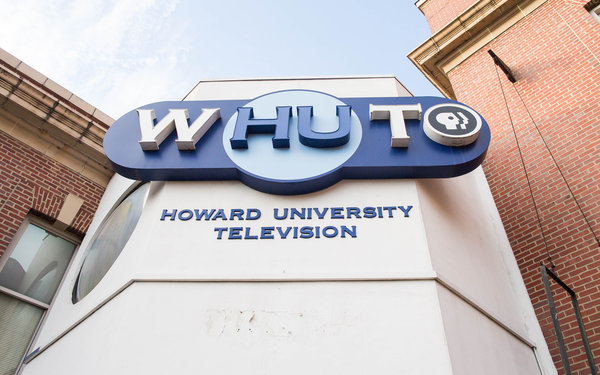
The public television station WHUT now reaches roughly two million households in the Washington area and remains the only black-owned public station in the country. (Zach Gibson/The New York Times)
Howard University, like other HBCUs, is facing tough economic times. But a proposal to sell its television station, WHUT, is being met with mixed reactions, according to The New York Times.
The station has been valued at $461 million by the Federal Communications Commission, and that could go a long way to help Howard keep its doors open. But by selling the station, the college will shut down a valuable Black media outlet that has also served as a training center for Black journalists since 1980. According to The New York Times, WHUT reaches about 2 million homes in the Washington, D.C.-area and is the only Black-owned public television station in the country. Some critics say the proposal to sell WHUT, or set up a channel-sharing arrangement, is not a smart financial decision.
“It’s like selling your house and still paying the utilities. It doesn’t make any sense,” said Sowande Tichawonna, an independent filmmaker and actor who interned at the station in the mid-1980s.
Howard is caught between a rock and a hard place. By selling WHUT, they will shut down a valuable media outlet that covers community news and Black issues. But the sale could generate millions of dollars for the college. Mark Spradley, a private equity executive and Howard alumnus, said the college needs to look at the decision as a purely dollars and cents issue.
“You are talking about substantially increasing your endowment in a year,” said Spradley. “That doesn’t come from picking stocks.”
On the other side of the argument are those who feel keeping WHUT open is more important than generating money for the school. Supporters of the station say it provides an important voice for the Black community. The Howard Media group, a group of faculty members and graduate students from the School of Communication, published a position paper last month arguing the college had a responsibility to its students and the community to keep the station open.
“Diversity of ownership in U.S.-based media is generally at risk, but in this DC-metro market, diversity in television broadcast has particular salience. WHUT-TV provides programming not available on the other local public (majority-owned) WETA-TV and MPT-TV,” said the paper. “If WHUT is sold, there will be no TV station to showcase Black History month, or documentaries on Chinese, Italian, Jewish and other ethnic histories.”
Leah A. Henry, a senior majoring in journalism who has worked at WHUT, told The New York Times, she sees both sides of the argument.
“When I think of all the opportunities that Howard would have with millions of dollars in their pocket to help students, of course I would want Howard to be able to do that,” she said. “But on the other hand, I’m a journalism student and so I know as a fact as a journalist, I would not be trained in the manner I am trained in if the station were to go dark.”
Sara Lomax-Reese, president and general manager of WURD Radio, said that having a vibrant Black press was still important.
“I think it is vital and critical to have a specific outlet for this population,” said Lomax-Reese in an interview on WHYY Public Media. “The mainstream media is still very separate and there are not a lot of opportunities [for black people] to speak and to be heard.”
The final decision about the future of WHUT will be made by the college’s board, headed by President Dr. Wayne A.I. Frederick. The board has several options. They could opt to sell the station outright, trade the spectrum for a less valuable frequency or opt for a channel-sharing agreement, which would allow the station to stay on the air as a renter on another broadcaster’s spectrum.
With Howard and other HBCUs facing tough times, Black students are more likely to look at white universities. But recent campus protests show those schools have their own problems.