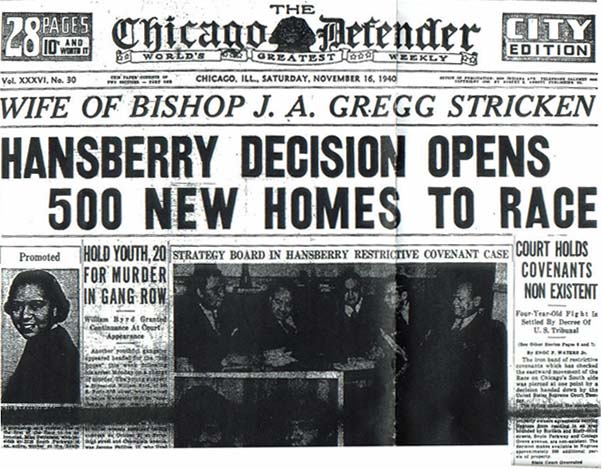
In 1940, Hansberry Vs. Lee Ruled That Blacks Cannot Be Barred From White Neighborhood
7 Unknown Facts About the Legendary Supreme Court Case
1. According to the University of Chicago Library News, on May 26, 1937, Carl Augustus Hansberry, a prominent real estate broker, and his wife, Nannie Louise Hansberry, a schoolteacher and ward committeewoman moved their family to Woodlawn, an all-white neighborhood near the University of Chicago.
2. A group of Chicago landowners agreed to place a racially restrictive covenant on their land. Quimbee states that under the agreement, the land could not be “sold, leased, or occupied by any person of color
for a set period of time.
3. According to African American Registry, a white woman, Anna Lee, who was one of many signatories of a restrictive covenant by Woodlawn Property Owners’ Association, filed suit against Hansberry for $100,000.
4. The covenant would not be effective unless 95 percent of the owners in the area signed it. Quimbee mentions that roughly 54 percent signed, but in an earlier class action suit concerning the covenant (Burke v. Kleiman -1934), it was stipulated that 95 percent of the owners signed.
5. Long Civil Rights Movement states Lee claimed that more than five hundred landowners had signed the agreement, which stated that it would be ineffective unless signed by 95 percent of the owners. She claimed that Hansberry had bought and occupied the land despite knowledge of the covenant. Lee won her case in circuit court and in the Supreme Court of Illinois. According to University of Chicago Library News, Hansberry, his wife, their lawyer Earl Dickerson and several other members of an NAACP litigation team, appealed the decision to the Supreme Court of the United States.
6. According to the Long Civil Rights Movement, Dickerson argued that the required percentage of residents had not signed the agreement, thus voiding the contract. The Supreme Court of the United States reversed the Supreme Court of Illinois’ decision in November 1940 basis of the Fourteenth Amendment’s due process rights, arguing that it was unfair to allow the 54 percent of the neighborhood landowners who had signed the covenant to represent the 46 percent who had not.
7. Playwright Lorraine Hansberry was Carl Hansberry’s daughter. Her experience in the Chicago neighborhood inspired her legendary play, A Raisin In The Sun.