
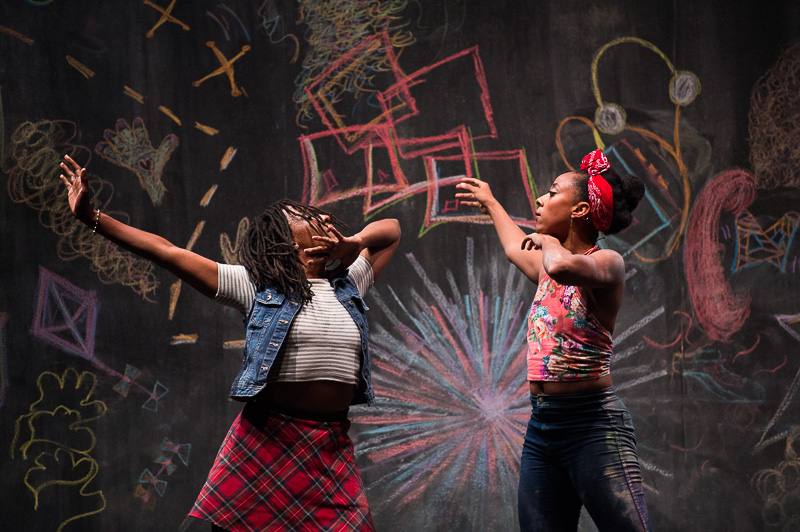
Photo by Christopher Duggan with Beatrice Capote and Fana Fraser.
Prolific choreographer Camille A. Brown is also a playwright with major productions under her belt, in addition to her illustrious career as a dancer. Her latest work, Black Girl: Linguistic Play, is in the midst of a 10-city national tour. Brown has worked on major stage productions since 2002 and she has earned numerous awards for her excellent choreography. In 2004, she launched her own dance company, Camille A. Brown & Dancers. Her first production under the banner was Demetia’s Serenity.
Brown reflects on an old interview in a Midtown Manhattan coffeehouse about her former production Mr. Tol E. Rance:
“I’m exhausted by the stereotype,” she said. “I live between the angry Black female and the strong Black female stereotype. I thought, ‘There’s got to be something else I want to talk about to contribute to this political climate — because we all know the struggles.’ Those are the things that get pushed to the forefront. But what are the things that celebrate us and uplift us, and are culturally specific?”
Black Girl: Linguistic Play is a six-woman play that features the rich games, chants and nursery rhymes that played an important role in her girlhood. The play shows the development of young Black women in an urban environment. The maturation process is displayed through the various forms of dance and movement Brown has employed throughout her play. She uses “social dancing, double dutch, steppin’, tap, Juba, ring shout, and gesture as the black woman’s domain to evoke childhood memories of self-discovery.”
Brown opens the work herself, with a remarkable, rhythmically complex solo on a multilayered set of platforms, suspended mirrors and a wall that appears decorated with graffiti, according to the Los Angeles Times.
The play is currently showing in Los Angeles at the RedCat Theater.


