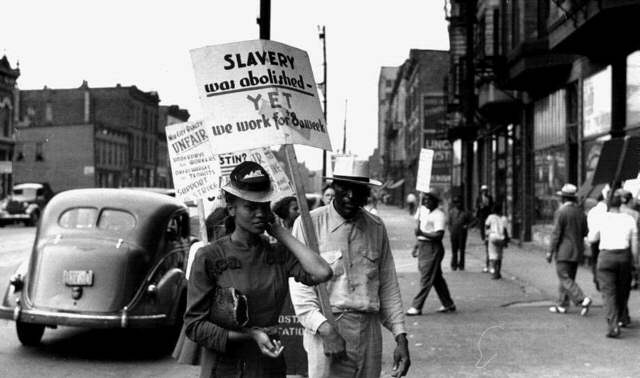
Racist Views Drove Chicago’s Housing Policies
In 1934, Dr. Homer Hoyt, a Chicago researcher and chief economist of the Federal Housing Administration, wrote in “One Hundred Years of Land Values in Chicago: The Relationship of the Growth of Chicago to the Rise of Its Land Values, 1830–1933” that particular groups of people are more desirable than others. Whites of Anglo-Saxon heritage were the most desirable according to his book. The second tier consisted of Northern Italians, Czechoslovakians, Polish, Lithuanians, Greeks, Russian Jews of the lower class, South Italians, and at the bottom, Blacks and Mexicans as reported by Slate. During Hoyt’s time at the FHA, his research and analysis provided the framework the FHA used to assess the risk a neighborhood posed for mortgage lenders.
 Redlining
According to the Washington Post, the government-sponsored Home Owners’ Loan Corporation drafted maps of American communities in the early 20th century to sort through which neighborhoods were worthy of mortgage lending. This act led to a policy called redlining in U.S. cities, where new, affluent, homogeneously white housing areas received green lines, while areas close to where Blacks lived were often circumscribed by red lines. Banks and insurers soon adopted the HOLC’s maps as tools for lending and underwriting decisions. While this discriminatory practice was by no means unique to Chicago, Coates writes, “Throughout the 20th century — and perhaps even in the 21st — there was no more practiced advocate of housing segregation than the city of Chicago.”