Darnell Ferguson, Owner and Executive Chef of SuperChefs
For many business owners, the road to entrepreneurship is a tumultuous journey filled with roadblocks that detour people from continuing to the finish line. Encountering bumpy roads did not prevent one man from accomplishing his goals, and them some.
Born in Philadelphia and raised in Ohio, Darnell Ferguson was raised by his mom and stepfather. He credits them for providing a good life but according to UrbanMaxx.com, he struggled in high school and transferred to a vocational high school that offered culinary arts courses.
“That was also at the time when Emeril was huge and I liked what he was doing, so that was one thing that really caught my eye. I liked the uniforms, the professionalism,” Ferguson told UrbanMaxx.com. “I liked everything that wasn’t like what I was used to.”
After graduation, Ferguson went to Sullivan University in Louisville, Kentucky to further his pursuit of becoming a chef. However, he was met with disappointment after discovering his academic funding was only partial. Although excelling in Sullivan’s Culinary Arts program, he started selling drugs on the side to make ends meet.
Fortunately, he was able to graduate but continued to sell drugs and was arrested – eight times in three months. He lost everything he owned, including his place of residence, and eventually became homeless.
“The last time getting locked up, I remembered being in class and them talking about being a statistic and how once you get in the system you can’t get out,” he said. “I started thinking that now I’m the guy that I didn’t want to be. That’s when I told myself that I was going to get serious about something I know that I can do, which is cooking.”
After working many jobs in the culinary industry and battling anger issues, Ferguson told UrbanMaxx.com that he started going to church, Southern Christian.
“I didn’t know God was real. So that for me was a shock. I wish I would have known this a long time ago but I wouldn’t have listened then, even if you told me. That’s just the truth about it,” Ferguson stated.
A confrontation with his boss left Ferguson fired and unemployed for a year. During that year, he focused on church and opening his own restaurants. He found two investors, one canceling on him at the last minute, and ultimately ran into a restaurant owner who offered Ferguson to lease the space for breakfast only – a concept known as “Pop-Up”. He would sublease space, mostly in other restaurants, for a short amount of time.
Ferguson named his pop-up restaurant SuperChefs, after his nickname throughout his culinary career and his time at 2008 Olympics in Beijing, China, where he was one of 22 chefs chosen. Ferguson told WHAS in Kentucky that although the pop-up model helped him get a lot of loyal costumers, the concept forced him to change locations a few times due to the lease expiring or the respective restaurant closing down.
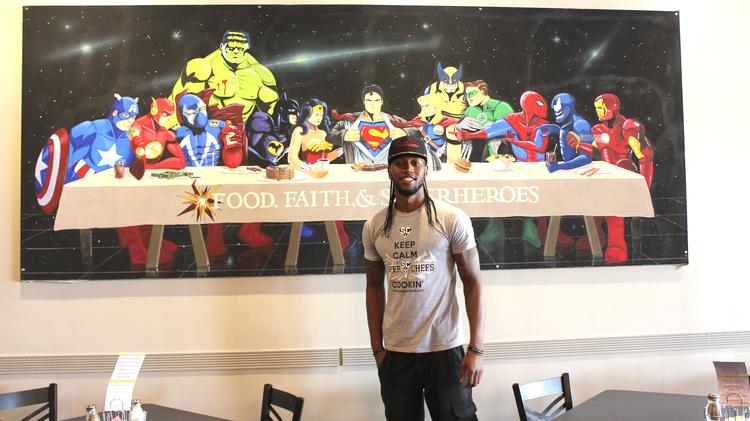
After a few years of changing locations, the 28-year-old chef opened SuperChefs in June, in a 4,500-square-foot space. He now employs approximately 35 people. His restaurant is adorned with framed pictures of various Marvel Comics and DC Comics superheroes.
Staying true to his passion and journey, SuperChefs’ motto is “food, faith and superheroes,” which can be seen on one of the walls of the restaurant.