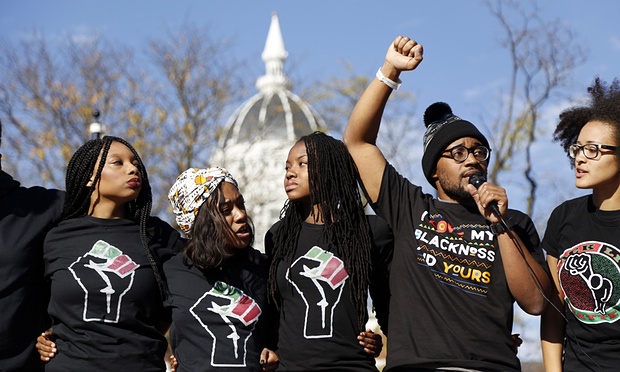
 After the resignation of University of Missouri President Tim Wolfe earlier this week, the student protests at Ithaca College, Princeton, and Yale have brought the racial issues that plague higher education to the forefront. Many would say that racism is long gone but students have taken to social media and the streets to let it be known that racism is alive and well, and they are not taking it any more.
In the wake of Mizzou graduate student Jonathan Butler’s week-long hunger strike, Twitter has witnessed racist backlash, racism denial, and flat out bigotry. Many conservatives would deem universities as bastions of liberal ideology, but the events of late have proven that colleges have a long way to go to become inclusive and prevent acts of racism and terror.
According to the University of Missouri, Black students comprise 7 percent of the student body while whites comprise 77 percent. At Yale, 8 percent of the student body is Black. Ithaca College fairs far worse, with only 4 percent. The small number of Black students may reinforce the racial issues at those campuses.
Consequently, Black students have created the hashtag #BlackOnCampus to prove that college campuses are not safe havens for diversity.
Sitting in lecture halls like #BlackOnCampus pic.twitter.com/CMBB8GJK60
— philip lewis (@Phil_Lewis_) November 11, 2015
This tweet is timely because of the recent threats made by white Mizzou students.
Student wears BP vest after death threats @PennState 2001 #BlackOnCampus #ConcernedStudent1950 @_JonathanButler pic.twitter.com/zgl6LtEqDp
— Robin Hoecker (@RobinEHoecker) November 11, 2015
https://twitter.com/SongOfTreasure/status/664506352690176000
Getting 4 [debt inducing] yrs to make up for the previous 12 yrs dedicated to convincing you you have no history or value. #blackoncampus
— jesse Williams. (@iJesseWilliams) November 11, 2015
Taking statistics at Stanford was uninteresting. Then I took a Duke stats course focused on racial justice. Changed my life. #BlackOnCampus
— Samuel Sinyangwe (@samswey) November 11, 2015
This tweet perfectly encapsulates the belief that Black students could not be successful without handouts.
Yeah, I'm tired of you thinking affirmative action got me into UT when I was in the top 6% of my class 😊😊😊😊😊😊😊😊😊😊😊😊😊😊😊😊😊😊😊😊😊 #BlackOnCampus
— Bria Arnese (@briaarnese) November 11, 2015
https://twitter.com/SankofaBrown/status/664531915953856512
When you mention that you received a scholarship, & classmates ask what sport you play B4 acknowledging that it was academic. #BlackonCampus
— Neale (@AbeFroman) November 11, 2015
Being called a "reverse racist" by many of my fellow White peers for bringing up White privilege in American society. #BlackOnCampus
— T R E Y (@treydaze_) November 11, 2015
Y'all I wish I could make #blackoncampus a cyber safe space because white people can never let us be.
— Kayla Reed (@iKaylaReed) November 11, 2015
#BlackOnCampus Telling the administration about racism, and them telling YOU to solve it. Like you work there. Like you aint a student.
— derecka (@dereckapurnell) November 11, 2015
https://twitter.com/HollaBlackGirl/status/664520716281229312