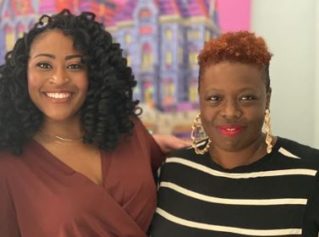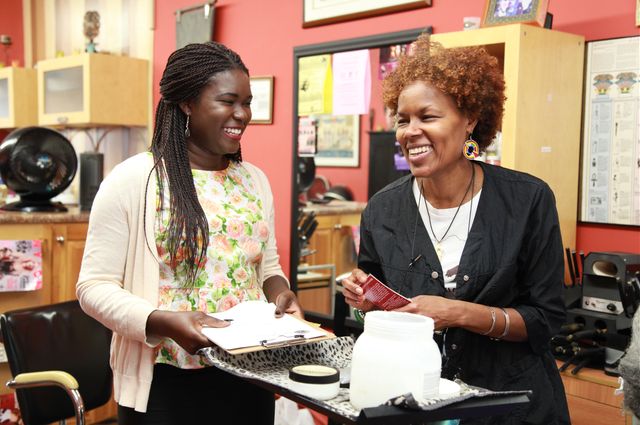
UCLA Ph.D. student Teni Adewumi (left) talks to a hair stylist about the potential risk of some hair products. Adewumi is hoping to persuade the City of Inglewood to pilot a program promoting healthy hair salons.
Teni Adewumi, a Ph.D. candidate in environmental health sciences in the UCLA Fielding School of Public Health, is spreading the word about the hidden dangers in hair and nail salons. The Nigerian-American student began shining light on the issue last summer when she started working for the L.A. nonprofit, Black Women for Wellness’ Healthy Hair Initiative project as part of a partnership between the Occupational Health Internship Program and the UCLA Labor Occupational Safety and Health program.
To gauge how much of a health risk certain beauty products pose, Adewumi questioned salon workers in the South Los Angeles area about the types of chemicals they’re exposed to and questioned them about any health challenges they faced as a result. Some stylists had worked with toxic chemicals for so long that their fingerprints had eroded. Others reported adverse reproductive outcomes, such as miscarriages and uterine fibroids. However, because miscarriages are very common and fibroids reportedly have a genetic link and have been linked to Vitamin D deficiency, it’s difficult to say whether beauty products played any role in their development.
Regardless, Adewumi urged stylists to utilize protective equipment to minimize their health risks while working, to take steps to properly ventilate their salons and to educate themselves about “greener” health care products. In recent years, aficionados of natural hair have flocked to styling products free from sulfates and the preservative methylparaben, which has been linked to cancer.
“This is an industry that isn’t regulated, and many of the products include ingredients that are known to be possible carcinogens, endocrine destructors or allergens,” Adewumi told UCLA’s newsroom. “These professionals are exposed both from using the products on themselves and from using them on their clients.”
Before pursuing graduate studies at UCLA, Adewumi developed an interest in safe working environments. She won an occupational health and safety internship at Fortune 500 company, Medtronic. The internship turned into an 18-month gig. Her experiences there led Adewumi to pursue a master’s degree in industrial hygiene at UCLA’s Fielding school. In June, she won admission into the Ph.D. program in the Fielding school’s Department of Environmental Health Sciences.
As Adewumi pursues a doctorate, she continues to advocate for salon workers and customers. She’s currently trying to pilot a Healthy Hair Salon program in Inglewood, California. She works with the California Healthy Nail Salon as well. Nail salons have also raised health concerns in recent years, as the chemicals commonly found in salons, including nail polish, contain toxic chemicals. Janette Robinson Flint, Black Women for Wellness’ executive director and founder, applauds Adewumi’s work.
“Everyone knows these beauticians and hair stylists inside of African-American communities,” she said. “If this group of professionals is empowered to share health knowledge, it has the potential to disseminate widely inside of our community.”
Flint went on to praise Adewumi’s for traveling from salon to salon to survey workers and clientele about their toxic product exposure.
“There is an important intersection between our environment, our work and our health,” Adewumi says. “That is what drew me to this field.”
While it may not be possible to avoid toxic chemicals in hair and nail salons, the Environmental Working Group can give the goods on the products to use at home. Enter a product in the EWG’s cosmetics database, and it will break down the chemicals in the item and show how potentially harmful they are.
The database is one tool consumers have to make better health choices. Some women have rearranged their entire medicine cabinets as a result.
Swapping out tried-and-true products for their greener counterparts may prove challenging, but the move could end up being lifesaving.