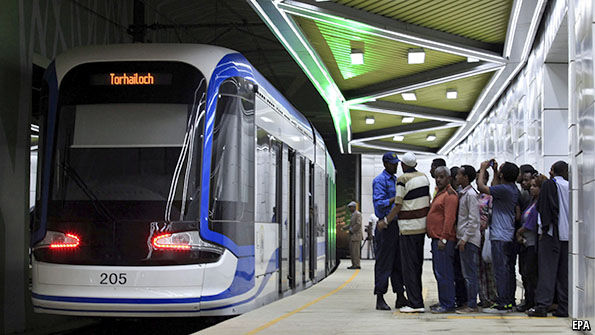
 GETTING around African cities is famously stressful. Whether in Nairobi, Lagos or Johannesburg most journeys involve negotiating roads clogged with honking cars and choked with fumes. This is also true of Addis Ababa, Ethiopia’s fast-growing capital. But it is now possible to make at least some journeys there without braving the hectic streets. On September 21st, the city opened the first part of its new urban metro. It is the first light rail system to be built anywhere in sub-Saharan Africa, though a few South African cities have commuter rail services.
The open line runs 17km (11 miles) from industrial areas in the south of Addis Ababa to the centre; a second east-to-west line of the same length is still being built. The two lines, which have their own dedicated power grid, will be able to carry 60,000 passengers per hour when fully operational. Fares are 6 Ethiopian birr ($0.27) per ride.
That Ethiopia has built Africa’s first metro is illustrative of the country’s development in recent years: its economy has grown at rates of 10% per year for most of the last decade, partly thanks to grand infrastructure projects like this one. But it is evidence also of Chinese expansion across Africa. A Chinese loan paid for 85% of the $475m the Addis Ababa metro has cost; astonishingly, the line was built in just three years with plenty of imported engineering help. It will be run for the next five years by the Shenzhen Metro Group and China Railway Engineering Corporation. Chinese money is also paying for a new full-sized railway in Ethiopia, connecting Addis Ababa to Djibouti, which is planned to open next year, as well as new lines in Kenya and Nigeria.
But other metro projects in sub-Saharan Africa are rare. Lagos, Nigeria’s biggest city, has had plans for a light rail transit system for several years now, which the World Bank has helped to fund; but construction has been continually delayed. There is much fighting over what has happened to the money already spent. Other large African cities, such as Nairobi, are investing more in roads than in rails. Commuters hoping to get onto a train and skip the traffic will have to keep waiting.
Source: www.economist.com