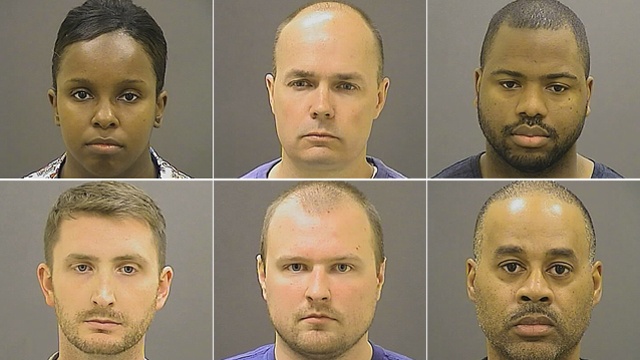
 A judge ruled that the six Baltimore police officers indicted in the April death of Freddie Gray will be tried in the city of Baltimore.
The Baltimore Sun reported that Circuit Court Judge Barry Williams found the defense failed to prove the officers would not receive a fair trial in the city.
“The citizens of Baltimore are not monolithic,” Judge Williams said in his ruling. “They think for themselves.”
Counsel for the defense argued that the media coverage of this week’s $6.4 million settlement between the city and the family of Freddie Gray, as well as a fear of future unrest and comments from public officials, would mean that jurors would be biased.
However, Williams was unconvinced, saying it was wrong to “assume they cannot be fair” without questioning potential jurors. The judge also did not believe that media coverage had influenced local residents any more than people elsewhere, considering that coverage was “local, state, national, international.”
“Nobody knows what the sentiment of the jurors are until you ask them questions about it during jury selection,” Michael Schatzow, the chief deputy of the Baltimore State’s Attorney’s Office said to Williams. He added it was “insulting to the citizenry of Baltimore” to assume an impartial, unbiased jury could not be found among 300,000 people.
Gray, 25, was taken into custody on April 12, having suffered a spinal cord injury. He slipped into a coma and died a week later, sparking protests and unrest. Gov. Larry Hogan called in the National Guard, and Mayor Stephanie Rawlings-Blake enacted a week-long nightly curfew.
Although an argument can be made for changing a venue in order to increase the likelihood of an impartial jury, leaving few excuses for the officers if they are convicted outside of Baltimore City, there are compelling reasons to allow the local community to be in judgement of a case in which they have been impacted.
“Rural and suburban juries are less likely to connect to the community conditions and more likely to excuse police as having a tough job and doing what is needed,” Dennis Kenney, a professor at John Jay College of Criminal Justice, told The Huffington Post. Kenney also said most juries take sides with the police, unless the officers’ behavior was inexcusable.
Two examples of juries in a changed venue who sided with defendants in a police brutality case involving Black victims include the first Rodney King trial, and the Amadou Diallo trial. In 1991, King, a Black motorist, was brutally beaten by police in Los Angeles, an incident which as caught on videotape by a bystander. The following year, the trial of four police officers charged with excessive force in King’s beating was moved to the Los Angeles suburb of Simi Valley, located 40 miles outside of the city. A jury of 10 whites, one Latino and one Asian American acquitted the officers.
Similarly, the 2000 trial of four NYPD officers charged in the death of Amadou Diallo was moved from New York City to the state capital of Albany, which is 160 miles away. A jury consisting of eight whites and four Blacks, including the forewoman, acquitted the officers on all charges. The Guinean immigrant had been killed in a hail of 41 police bullets, standing in the vestibule of his Bronx apartment, armed with no more than a wallet.
Meanwhile, writing for CNN, former federal prosecutor Laura Coates argued that the decision by the city of Baltimore to settle with the Gray family only makes it harder for the prosecution, increasing the likelihood a conviction of the officers would be reversed on appeal.
“It’s not a matter of whether Freddie Gray’s family should receive a settlement. They should. When a 25-year-old man allegedly suffers a spinal injury while in police custody, civil liability is inevitable,” Coates wrote. “It’s a matter of when it should have happened. As Mayor Stephanie Rawlings-Blake conceded, it is highly unusual for a settlement like this to predate the criminal trials.”