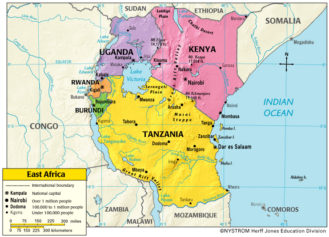
 NAIROBI — Power lines connecting the east African states of Tanzania, Uganda, Rwanda, Kenya and Ethiopia are expected to be completed within the next three years, helping improve supplies and power trading, a senior Kenyan official said on Thursday.
Power shortages are common across Africa and businesses often complain that poor or erratic supplies deter more investors and push up prices of local products, as many firms rely on costly generators.
Linking up national grids would provide a bigger pool of resources and mean one state can tap idle supplies in another.
A high-voltage line between Ethiopia and Kenya will be ready in 2017, a Kenya-Uganda link will be complete by the end of 2016, and a Kenya-Tanzania connection will be working in 2018, said Joseph Njoroge, principal secretary at Kenya’s Energy and Petroleum Ministry.
The Kenya-Ethiopia link will be a 500 kilovolt (kV) line, while the lines to Uganda and Tanzania will be 400kV. The line to Uganda would then connect Rwanda and Burundi. All the states, except for Ethiopia, are part of the East African Community trade bloc.
“In another two to three years, we should be having interconnections of Ethiopia, Kenya, Uganda, Rwanda and Tanzania,” Mr Njoroge told a regional power conference.
“The regional power interconnection project is a very critical solution,” he said.
Kenya, which relies heavily on hydro power, geothermal and other renewables, aims to expand installed capacity to 6,700MW by 2017, from about 2,500MW currently, and cut bills to consumers. Tanzania aims to double generation to 3,000MW by 2016.
Ethiopia aims to become a major power exporter through large new dams and other renewable energy projects. By 2020, it aims to add 12,000MW to its grid.
Other African regions have already connected their grids.
Southern Africa has a series of links between SA, Zambia, Zimbabwe and Mozambique, allowing them to trade power.
“We would expect that with such interconnections, we should take advantage of the huge renewable resources that we have in this region,” Mr Njoroge said.
Read more at bdlive.co.za.com