 No one much in the West paid much attention to Niger’s mining activities before 2003 and hardly anyone knew that Niger was an important uranium producer. All that changed in the run-up to the Iraq War where the “smoking gun” for the invasion of Iraq was the supposed attempts by Saddam Hussein of Iraq to obtain yellowcake from Niger to feed some sort of nuclear program. Subsequently the whole affair proved to be a bogus false-flag operation and the matter degenerated into a morass of lawsuits known as the Plame Affair. It turned out that a former U.S. ambassador had been sent to Niger to investigate the matter but his finding, that it was highly unlikely that Niger had exported any uranium to rogue states, was suppressed. This was too late though for Iraq as the allegations were used as the trigger for the invasion. The Coalition of the Willing turned out to be the Coalition of the Misinformed.
Leading (Sometimes) the Pack
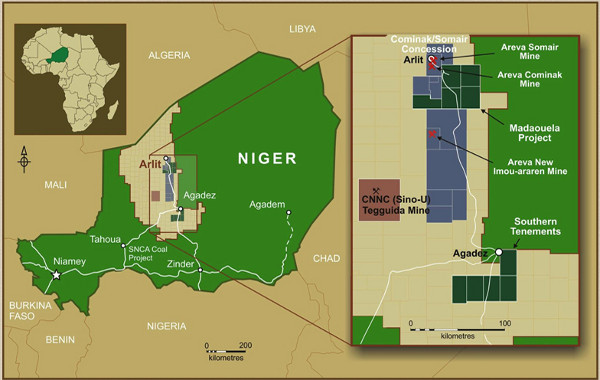
The one thing that was true was that Niger was one of Africa’s leading uranium producers, swapping first place over time with Namibia depending on which country was ahead on sales at any time. In 2011, the country ranked fourth (globally) in terms of uranium production by volume, accounting for about 8% of world production.
Niger has been mining uranium since 1971. It is currently the world’s fifth largest uranium producer, producing approximately eight million pounds of uranium per year, and its global market share has fluctuated between 5-9% over the last decade. It has accounted for as much as 72% of the country’s export revenues. Foreign direct investment in the sector from 2008 to 2012 (the most active period) was estimated to have been US$1.4 billion.
Read more at investorintel.com