The Atlantic Coast of Venezuela Now Includes Sovereignty Over Guyana’s Territorial Waters

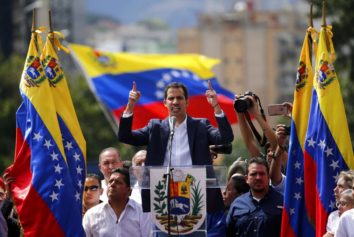
Venzuala president

Venezuela’s President Nicolas Maduro

GEORGETOWN, Guyana — Venezuela’s President Nicolas Maduro on May 27 issued a decree creating the “Atlantic coast of Venezuela”, which now includes sovereignty over Guyana’s territorial waters in the Atlantic Ocean off the Essequibo region. A map, issued to coincide with this decree, indicates that Venezuela is now claiming all the territorial waters within the 200 miles range and blocking Guyana’s access to its resources in this area of the Atlantic Ocean.

This new extension of Venezuela’s claim to Guyanese territorial waters was made official in the presidential decree, No. 1787, and published in the Ordinary Official Gazette No. 40,669, dated May 27, 2015.

It is the second decree asserting a claim to Guyana’s territorial waters; the first, issued by President Raul Leoni 47 years ago in July 1968, purportedly claimed “sovereignty” over a 12-mile strip of Guyana’s continental shelf along the Essequibo coast.

The Maduro decree is set amid Venezuela’s objection over oil exploration and concessions granted by Guyana to the US oil company, Exxon-Mobil, to explore 23,000 square kilometers of the Stabroek Block located within the area into which the new territorial claim is now extended. Earlier this year when Exxon-Mobil was about to drill an exploratory well in the area, Venezuela claimed the drilling area as part of its territorial sea. The oil company recently announced a significant discovery of hydrocarbons in the drilling area.

Read more at caribbeannewsnow.com
Democracy needs journalism it can trust.

This election season, the stakes are higher than usual — and so is the pressure on newsrooms to soften their coverage, stay quiet, or just disappear. Independent reporting, the kind that answers to readers instead of advertisers or political pressure, matters more in a moment like this, not less.

For over 14 years, Atlanta Black Star has stayed independent and reader-funded. We have no corporate owner and no shareholders telling us what to cover or how to cover it. That independence is also our biggest vulnerability: nothing protects it except readers choosing to fund it directly.

Newspaper ad revenue has fallen more than 80% since 2005, and local newsrooms are closing at a rate of roughly two a week nationwide. When outlets go under in a moment like this, it's rarely the independent, reader-funded ones that get to stick around.

We know a request for support isn't why you came here. But without readers choosing to fund this work directly, the depth of reporting we can do at home and abroad shrinks along with everyone else's. If you're not in a position to give, that doesn't change how much we value you as a reader.

If you are able to, a recurring contribution does more for us than a single one-time gift, because it lets us plan the next investigation instead of just the next invoice. It takes about 30 seconds, no long form, no account. Thank you for continuing to support independent journalism and freedom of the press.

Back to top