8 Things You Need to Know About the Mistreatment of Black People in Spain

Spanish Guardia Civil watch as would be immigrants from Africa sit atop a wire-meche fence after scrambling over two other border barriers on Spain's tiny north African territory of Melilla on August 13, 2014.  Some 600 people tried to scale the triple-layer six-metre-high (20-foot) razor-wire barrier that separates Morocco from Melilla in a pre-dawn assault today, said Irene Flores, spokeswoman for the Spanish government in Melilla. More than 60 of them had perched on the top of the border fence, she told AFP. AFP PHOTO / JOSE COLONJOSE COLON/AFP/Getty Images ** OUTS - ELSENT, FPG - OUTS * NM, PH, VA if sourced by CT, LA or MoD **

JOSE COLON/AFP/Getty Images

Spain built a barrier to keep Black people out.

According to a 2014 article published by The New York Times, “ten years ago Spain spent more than 30 million euros building up the barriers around Melilla and Ceuta, its two enclaves surrounded by Morocco on the northern coast of Africa, which offer the only land borders between the promise of Europe and the despair of Africa.” In fact, as citizens of Africa try to migrate to the European country, Spanish military police violently bring their efforts to an end. One victim, Abbdol Cisse, told The New York Times, “They had metal bars, and they hit our legs while we were climbing.” Moreover, patrolled barriers on the country’s borders with Portugal and France are nonexistent.
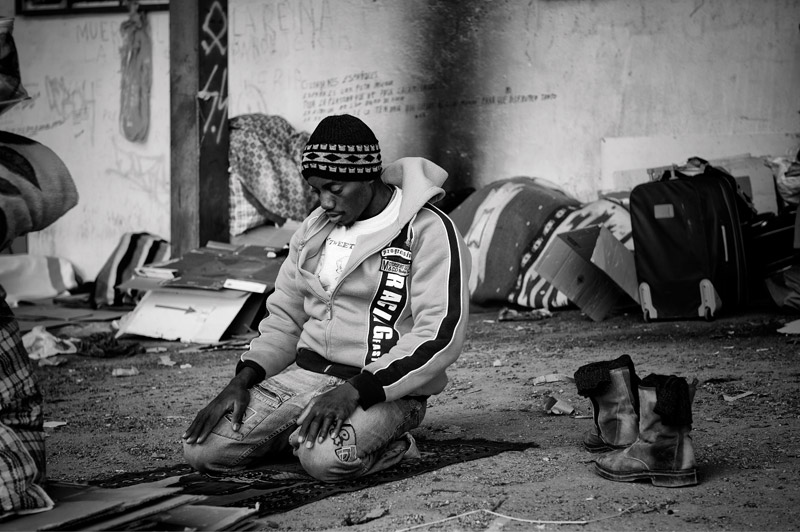
via illumination.missouri.edu

via illumination.missouri.edu

Black people in Spain are subject to hate crimes.

Black people of Spain are often inhumanely harmed simply because of the color of their skin. While Black people account for less than 10 percent of the population in Spain, a 2015 article published by expatica.com states that racially motivated hate crimes accounted for 37 percent of last year’s criminal activity. Just last December, a Spanish man set a warehouse that inhabited African migrant workers ablaze in Barcelona. A 2014 article published on thelocal.es, claims that the man demanded that they pay rent although it was not yet the end of the month. When the 14 Africans were unable to do so, the 24-year-old man returned with five individuals and proceeded to set the warehouse on fire. Upon his arrest, he “shouted racist insults and smashed the window of a police patrol car.”


Still independent.

We hope this story was worth your time. For over 14 years, Atlanta Black Star has stayed Black-owned and independently run. We didn't get here by waiting on ad budgets that were never built to prioritize us. Our readers did that.

Corporate support for Black media has always been thin. Outlets like ours get roughly 1% of the $170 billion spent on U.S. advertising each year, and that margin is shrinking further as advertisers walk back the DEI-linked commitments they made in 2020. That's the backdrop. It's not why we're asking.

The wider picture isn't any steadier. Newspaper ad revenue has fallen more than 80% since 2005, and local newsrooms are closing at a rate of roughly two a week nationwide. When outlets go under, it's rarely the ones built to center a Black perspective from the ground up that get to stick around.

We know a request for support isn't why you came here. But without readers choosing to fund this work directly, the depth of reporting we can do at home and abroad shrinks along with everyone else's. If you're not in a position to give, that doesn't change how much we value you as a reader.

If you are able to, a recurring contribution does more for us than a single one-time gift, because it lets us plan the next investigation instead of just the next invoice. It takes about 30 seconds, no long form, no account. Thank you for continuing to support independent journalism and freedom of the press.

Back to top