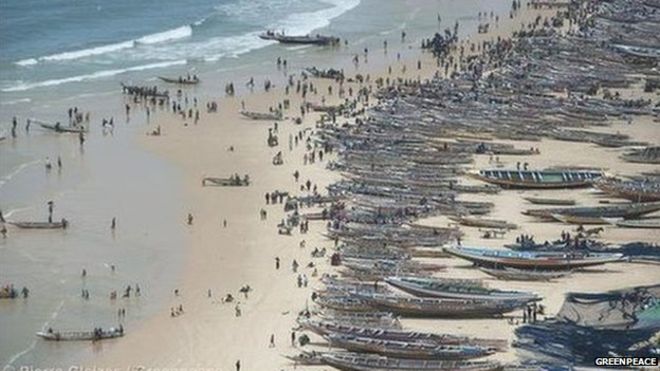
More than 70 Chinese vessels have been found fishing illegally off the coast of West Africa, Greenpeace says
Using information gathered from 2000 to 2014, Greenpeace said Chinese companies had fished in prohibited grounds or under-declared their catches.
Boats either turned off their identification systems or transmitted false location data, it added.
One company’s fishing capacity off the coast of Guinea Bissau is said to have exceeded its authorized limit by 61 percent.
The absence of efficient fisheries management in some West African states allows rogue companies to plunder marine resources, the BBC’s Thomas Fessy reports from Dakar in Senegal.
In less than a month, Greenpeace documented an average of one new case of illegal practice by a Chinese-owned boat every two days, but the report’s authors say they think that is only the “tip of the iceberg.”
Chinese companies were “unlawfully exploiting West Africa’s marine environment,” said Rashid King, head of Greenpeace East Asia’s China Ocean Campaign, in a statement.
“They were taking advantage of weak enforcement from local and Chinese authorities to the detriment of local fisherman and the environment.”
Mr Kang said unless the Chinese government controlled rogue fishermen, it would “seriously jeopardize” its mutually beneficial partnership with West Africa.
China came to West Africa’s aid during the Ebola outbreak, Mr Kang said, but Chinese companies were “exploiting” West Africa’s marine environment.
In the most recent cases, the Greenpeace ship MY Esperanza, which sailed off Senegal, Guinea-Bissau and Guinea last autumn, documented 16 illegal fishing activities by 12 Chinese vessels.
Read more at bbc.com