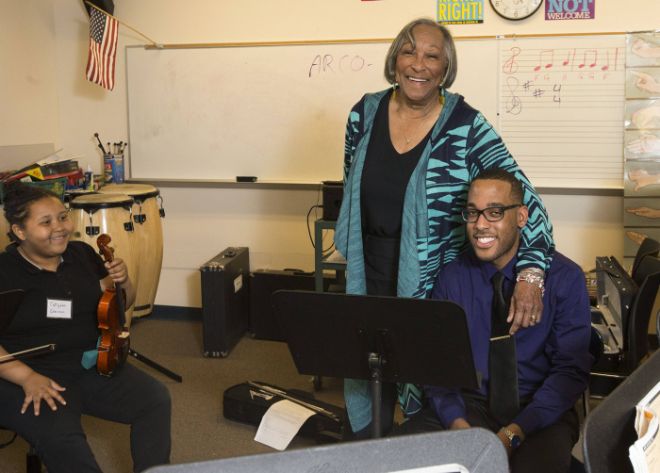
 In 2007, Catherine Willis founded Urban Strings, an ensemble in Columbus, OH, designed to introduce Black youths to classical music with the hope that they will eventually increase the disparate numbers of orchestras’ racial makeup.
With a membership of 40 players ages 7 to 18, Urban Strings accepts those of varying skills and backgrounds. But students are required to have at least six months of experience, acquired through private instruction or a school music program.
Although all elementary schools in the Columbus district offer beginning string classes, Willis said it can be difficult for many Black families to afford participating in the program.
Willis said the lack of Black people playing classical music professionally bothers her, as only about 4 percent of orchestra musicians nationwide are of Black or Latino descent, according to the League of American Orchestras.
Urban Strings is a nice way to change into those numbers. The group tackles an expansive musical genres — from Mozart and Beethoven to pop covers, gospel spirituals and jazz fare.
Willis, 82, said it is important in her work to incorporate the work of modern Black composers.
“I’m not sure people understand how important the arts are to children,” she said.
Willis was raised in Cleveland public housing, where she used classical tunes during her three decades as a teacher in Columbus schools to calm pupils after recess. “It put them to sleep,” she recalled with a laugh to The Columbus Dispatch.
More than 40 years ago, she also helped found Friends of Art for Community Enrichment—a nonprofit entity designed to introduce Columbus children to the art and culture of Africa and African-Americans. Her mission for the last 10 years has been to expose Black youths to orchestras, which requires funding. And she does that too, quite aggressively with politicians, local business people, organizations and individuals.
“She’s relentless, fearless, willing to do whatever it takes,” said Stephen Spottswood, a music-education major at Capital who was hired by Willis in 2013 to conduct Urban Strings, to The Dispatch. “Even in her seasoned age, she has more energy than I do.”
A basic violin, Spottswood said, costs about $25 a month to rent or $600 or more to buy new.
This month, Willis started an enrichment program for fourth- and fifth-graders at Ohio Avenue Elementary School, where she said she envisions a future recruiting pipeline for Urban Strings.
She applied a $3,500 donation from a central Ohio chapter of the Links Inc., an international service organization for Black women, toward the stipend for the time that Spottswood spends with the younger group — and a new wardrobe for its May 22 debut concert at the Near East Side school.
Halle Craig, 17, an upright-bass player from Lewis Center, told The Dispatch that Urban Strings is important to her.
“It allows me to learn more about my culture,” she said. Craig will perform with the orchestra at Olentangy Orange High School during the summer in Europe with American Music Abroad, a national program.
The donation from the Links will also provide scholarships to send students to an Urban Strings-sponsored summer camp. Older musicians, meanwhile, will take a summer road trip to give a performance in Atlanta — and make a few college visits along the way.
“What I really would like to do,” Willis said, “is perform more for children who live in urban areas — to have them see our kids doing this, let them hear If Carmen Was a Sista.
“Classical music is not just the William Tell Overture. They can get down.”