 In 1952, when the legendary Hank Aaron began his historic Major League Baseball career by leaving the Negro Leagues and signing with the Boston Braves, he was replaced by someone who would build a legacy of trailblazing that is far less known than what Aaron did in becoming the original home run king.
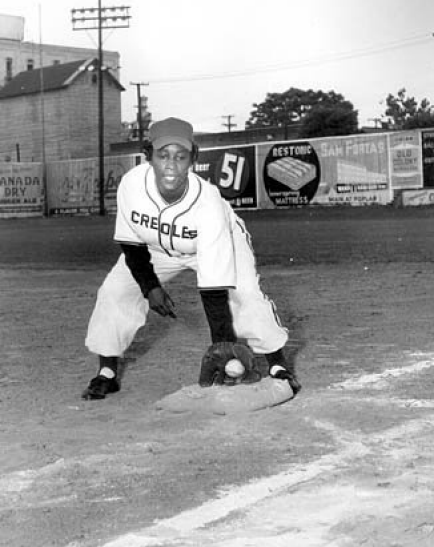
Toni Stone was not nearly the player Aaron became, but she—yes, she—was good enough to assume his roster position, breaking the gender barrier in pro baseball.
It’s a little-known fact pointed out by The Root that Stone, whose birth name was Marenia Stone, had pretended to be 16 when she was really 26 so she could sign on with the American Legion Junior League team, which had previously been open to teenage boys.
She then joined the barnstorming San Francisco Sea Lions, where she changed her name to Toni Stone. And from 1949 to ’53, she played on several semipro and Negro League teams. After Jackie Robinson broke the color barrier, more and more players fled the Negro Leagues to play in “The Bigs.”
Syd Pollack, owner of the Indianapolis Clowns, sought to replace Aaron with someone of talent and who would be a novelty to help draw a crowd. Stone was his answer.
But he was not expecting her to be all about the game and not the show. She was a skilled ballplayer who wanted to play ball—not dress in a shorts or a skirt as the all-white women of the professional women’s league did.
She said in a 1991 interview with the San Francisco Chronicle that she was routinely ridiculed by fans who did not want a woman playing among men.
“They’d tell me to go home and fix my husband some biscuits,” she said.
But she pressed on. Although she did not consistently get on the field, she accomplished something that gave her a life joy, she said to The Chronicle: She said she got a hit off of the great Satchel Paige.
“The happiest moment of my life” she said of the unexpected hit she got off of Satchel Paige.
Whether a myth or true—a historian said Paige was not at the site of the game Stone said she got her hit off of him—she represented something new at a time when chauvinism was rampant and women had their “place,” and it was not with men on the baseball field.
Stone played professional baseball for just one more year. At the end of the 1953 season, the Clowns sold her contract to the Kansas City Monarchs, replacing her with two female players, Connie Morgan at second base and Mamie “Peanut” Johnson on the pitcher’s mound. Her time on the Monarchs was unfulfilling, and she left after a season, returning to San Francisco to become a nurse and to care for her husband, who would live to be 103 years old.
She lived in relative obscurity until she was rediscovered and inducted into the Women’s Sports Foundation International Sports Hall of Fame in 1985—11 years before she passed away in Alameda, Calif.