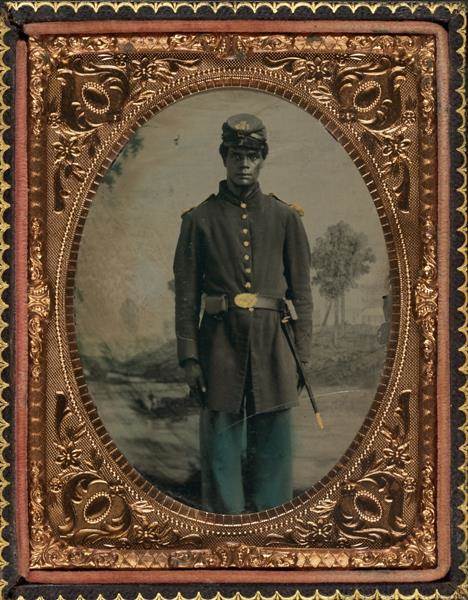
 At the Central Library in downtown Los Angeles, Black soldiers who fought during the Civil War come to life in the show “African American Military Portraits From the American Civil War.”
These men were the forgotten heroes of the country, and the gallery commemorates the 150th anniversary of the War Between the States and runs through Saturday.
The large-format images have been reproduced from original antique photographs. They are clear and poignant photos that pay tribute to about 180,000 African-American men who fought for freedom from 1861 to 1865, or until President Abraham Lincoln signed the Emancipation Proclamation.
The exhibit features authentic artifacts, including bullets, chessmen or dominoes the soldiers carved and uniforms that replicate the originals that are too delicate and fragile to be used. The installation draws from various collections, including the Liljenquist Family Collection and the Gladstone Collection, both housed at the Library of Congress in Washington, D.C. Additional images came from the Beinecke Rare Book & Manuscript Library at Yale University.
It is filled with interesting information and stories. For instance, for their service, Black soldiers and sailors of the Civil War took home $10 a month, while their white counterparts earned $13 monthly. Some Black men fought in battle, while others had noncombative duty, including feeding and caring for white officers’ horses.
Also, curator Ed Garcia of the California African American Museum said to nbcnews.com: “George St. Pierre Brooks. There’s a movie in his life story waiting to be made,” adding that Brooks was forced to fight for the Confederacy until he was captured, switched sides and fought for the North. He moved to Canada in 1900 and then volunteered to fight in World War I. He went on to perform with P.T. Barnum (pre-circus days), challenging local people to races in traveling shows. He also volunteered as a civilian cook during the Spanish American War.
As the exhibition comes to a close, Garcia said he’s pleased with the information he has helped impart with visitors.
“One older gentleman walked into the exhibit with his family, opened arms and declared, ‘These are my heroes.’ And I told him, ‘They should be everybody’s heroes.'”