 Following an insensitive and insulting article bashing the upcoming diverse TV pilot season, Deadline editor Mike Fleming Jr. issued a public apology on Nellie Andreeva’s behalf. Rather than push the publication back into the public’s good graces, however, the apology only proved why inclusivity, not diversity, should be the real focus when it comes to incorporating Black stories and talent in prime time television.
For those who managed to avoid the astonishingly tone-deaf, racially charged article about how Black actors are now stealing all the opportunities from white stars, it was a bit bewildering.
Andreeva’s article suggested that Hollywood’s landscape was no longer welcoming to white talent as she bashed casting directors who had the audacity to ask for Black and Hispanic stars to fill certain roles.
After industry leaders and social media users alike took aim at Deadline for the piece, co-editor-in-chief Mike Fleming Jr. has issued an apology.
Andreeva, the one who spewed her misguided and offensive opinion into the article, has not issued a public statement of remorse.
In addition to Andreeva quietly avoiding anymore public attention, Fleming’s apology failed to tackle the root of the issue—all while defending the claims made in the article.
“My co-editor-in-chief Nellie Andreeva’s goal was to convey that there was such an uptick of TV pilot casting of people of color that it pinched white actors who’ve historically gotten most of the jobs, and to question if this could last if it was being treated as a fad,” Fleming wrote in a column along with former Variety editor Peter Bart. “All this was undermined by that headline (which we changed after the fact) and a repetition of the word ‘ethnic’ that came off cold and insensitive.”
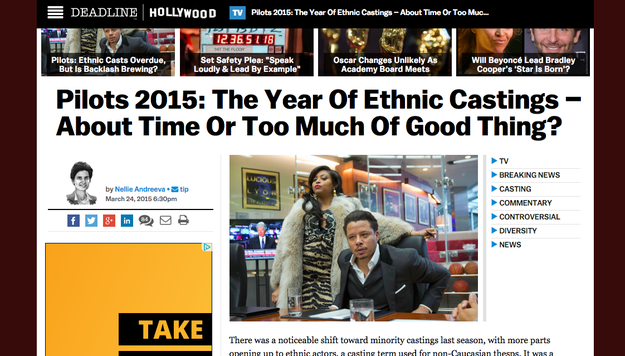 The headline in question read, “Pilots 2015: The Year of Ethnic Castings—About Time or Too Much of a Good Thing?” The article then departed on its journey to defend the position that the diversity in the new pilot season was “too much of a good thing” (i.e. a bad thing).
He then insisted that Andreeva’s views did not fall in line with the rest of the team at Deadline and assured the public that he believes diversity in casting is a “wonderful thing.”
“The missteps were dealt with internally; we will do our best to make sure that kind of insensitivity doesn’t surface again here,” he continued. “As co-editors in chief, Nellie and I apologize deeply and sincerely to those who’ve been hurt by this. There is no excuse.”
It’s a surprising line in the apology that followed Fleming tossing out a variety of excuses and explaining why the article was simply misunderstood. It ultimately suggested that the readers were too distracted by a strong headline to really focus on the article’s content.
For many readers, however, the lackluster apology was no surprise and Andreeva’s silence was even more expected.
Perhaps what was more surprising was just how well Andreeva’s article and the following apology prove, yet again, why diversity shouldn’t be the ultimate goal in Hollywood.
Instead the focus should be on inclusivity.
The difference is that one focuses on getting Black people in the business. The other dives into issues of making the entire landscape a welcoming environment for people of all colors and backgrounds.
One counts how many Black people are on television screens while one counts how many authentic stories are being told from a Black perspective while utilizing diverse talent.
Hollywood has welcomed Black leads, handed them awards, watched them dominate ratings and will now usher in a historically diverse TV pilot season.
This wave, however, did not extinguish the flames of racial insensitivity and discrimination that would cause a popular TV editor to insist white stars are missing out on too many opportunities because of diverse casting.
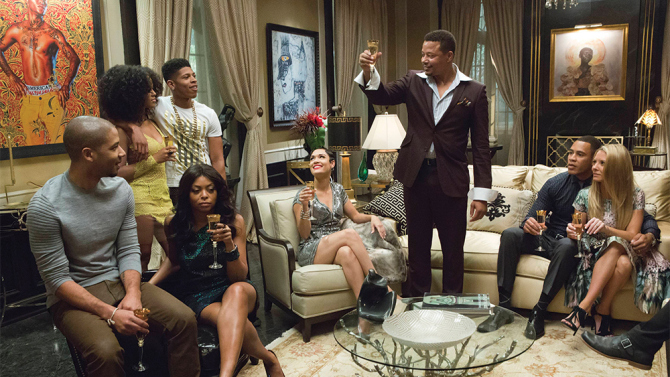 It’s evidence that the decision to diversify television pilots in 2015 was made out of sheer corporate concerns as executives wanted to get their slice of the Black consumer pie.
Black viewers launched Empire to ratings greatness, Black Twitter has the social media pull that turns shows into viral sensations and Black stars were the ones responsible for some of the most captivating primetime performances to hit network television. The incentive is in profit, not morality or equality.
That creates a foundation where Black stars will be allowed into Hollywood, not welcomed there.
So as viewers celebrate a long awaited diverse TV season, they must not become comfortable and convince themselves that Hollywood has evolved into an inclusive space for talent of all backgrounds.
After all, the presence of Black faces does not account for the countless Andreevas who will be sucking their teeth, folding their arms and somehow convincing themselves that Black talent doesn’t deserve the opportunities they have finally been allotted following decades of white washed television that shut them out.