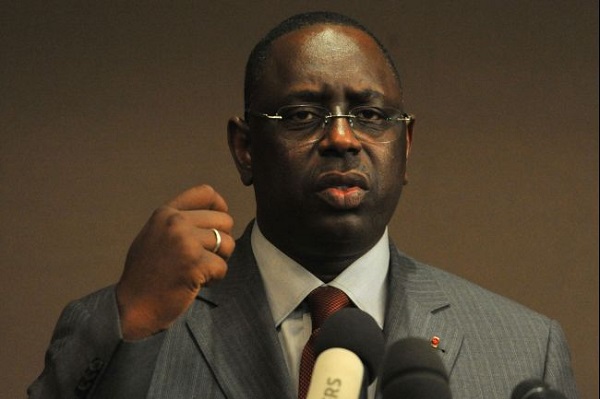
Senegalese President Macky Sall
Senegalese President Macky Sall has called on African countries to allocate more than 1 percent of gross domestic product to research, if the continent is to make headway with its development agenda. He pledged to become a continental political champion for the cause, alongside the African Union Commission.
Addressing more than 500 delegates including ministers of education, vice-chancellors, senior government officials and local and international partners in higher education, Sall said Africa was at a crossroads, as it had the world’s lowest enrollment rate in higher education.
“On average Africa’s participation in tertiary education stands at only 7 percent, compared to the global access rate of about 30 percent,” said Sall. The Senegalese president was opening the higher education summit on “Revitalizing Higher Education for Africa’s Future,” held last week in Dakar.
Affirming his support for the initiative, Sall said he would lobby fellow African presidents not just to allocate 1 percent of gross domestic product to research and development, but to also pump more resources into higher education studies in STEM – science, technology, engineering and mathematics.
He said he supported the African Union idea of moving towards a single African passport. “If agreed upon, the move would enhance rapid student and academic mobility on the continent,” said Sall.
The crux of the matter is that students have become increasingly mobile as the demand for higher education continues to rise. “Now is the time to build Africa’s higher education space and to disseminate knowledge beyond language barriers,” the president added.
He also urged African universities to embrace rankings, accreditation and harmonization of degrees and other credentials.
African universities, Sall stressed, could not operate in isolation but needed to cooperate and respond to global trends in higher education. However, he was aware that this would not be easy because of established traditions.
Addressing the forum, Aicha Bah Diallo, chair of TrustAfrica – lead organizer of the summit – said that if Africa was to develop, it had to do so collectively.
Lack of progress in supporting higher education was the result of competition for resources between different sectors in African countries. In this regard, she supported higher education being recognized as a goal of its own in the post-2015 global Sustainable Development Goals.
Read more at University World News


