 As the Supreme Court takes up yet another challenge to President Obama’s Affordable Care Act, also known as Obamacare, a new analysis shows that millions could lose their coverage in the devastating ripple effect of shooting down federal subsidies for health care.
The Affordable Care Act has been one of the most controversial pieces of legislation of Obama’s time in office but even as many protested the universal health care plan, it seems that just as many could actually be benefitting from it.
Just as many former Affordable Care Act critics became supporters, however, it seems a new challenge to the health care plan could end in a serious shake up for those receiving government subsidies under the new act.
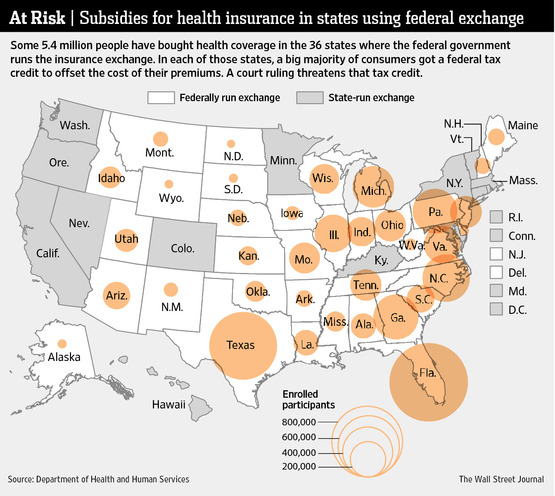
A study from the Urban Institute found that millions of Obamacare enrollees will be deemed ineligible for federal subsidies if the Supreme Court rules against the Obama administration in the King v. Burwell case.
The plaintiffs in the case insist that people who buy coverage on the federal exchange are not actually entitled to subsidies and claims that it is up to the state’s discretion to decide whether or not people will be eligible for them.
If the Supreme Court agrees and rules that not everybody will be entitled to the subsidies, a series of negative effects could cripple the plan and rid it of much of its usefulness.
“Researchers estimate that in this scenario about 8.2 million people would lose their health insurance,” the Fiscal Times wrote of the study. “This includes 6 million who would no longer have access to federal subsidies, 445,000 enrollees in the Children’s Health Insurance Program and another 300,000 in employer-based plans.”
To make matters worse, this would launch a ripple effect that would also cause premiums to sky rocket and possibly force another 1.2 million Obamacare enrollees to drop what would be extremely expensive health plans.
The idea of seeing Obamacare crumble was once something Erin Meredith, a fifth-generation Republican in Texas, would have dreamed about.
After becoming a single mother of two children and being hired by a company that didn’t offer benefits, Meredith’s opinion changed drastically.
Meredith is making about $30,000 a year at her new job but she’ll be able to afford health care thanks to those government subsidies that she used to view as nothing more than “government handouts,” the Washington Post reported.
She qualified for a subsidy of more than $130 a month, which slashed her premium down to less than $90 a month.
“I can still feed my kids and put gas in my car,” she told the Washington Post. “I’m not trying to go to Cancun or carry a Michael Kors bag. I drive a 2009 Mazda, and I’m just trying to make it in my little apartment and not be on government assistance.”
Many other residents who are currently benefitting from the universal health care plan echoed her sentiments.
For one Wisconsin woman, she just wished the act would have come even sooner.
Lori Zeitlow, 52, opened up to the Washington Post about her story, revealing that she was recently laid off from her graphic-design job.
Since money was tight, she avoided seeing a doctor for years because she couldn’t afford health insurance.
 When she finally enrolled in a plan under the new act she was able to get health care for $30 a month and go see a doctor while the government picked up a nearly $400 monthly tab to cover her plan.
Her first physical in years revealed she had breast cancer that, unfortunately, had spread to her lymph nodes.
While she is finally able to receive the medical attention she so desperately needs, the Supreme Court’s decision will ultimately decide if other Americans are left playing guessing games with their health because they can’t afford health insurance.
The Court is expected to make a decision in June but even if they shoot down the federal subsidies they may be able to propose an alternative method to ensuring millions of Americans are able to receive the health care they need.
Unfortunately, many experts are guessing that any Congressional action “isn’t likely,” the Fiscal Times added.
There is also a chance that individual states could pass their own legislation to make residents eligible for subsidies but it would be hard to imagine enough states passing such laws on their own and preventing the dramatic spike in health care costs.