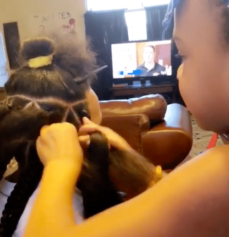
In Abidjan, hair can be a contentious topic. Many Ivorians are persuaded to eschew their natural hair in favor of chemical straighteners, wigs and extensions. Afros and dreadlocks are rarely depicted on local television, and those that wear their hair naturally can be shunned from their offices.
“I have one friend who has natural hair, and she has to wear a wig to work. They will not even let her inside the building with natural hair,” says Azi Oyourou, founder of Re-Zen Up, one of the few salons in the capital that specializes in natural hair styles.
The tide is slowly starting to turn, however, thanks in part to the efforts of a community movement, Nappys de Babi.
The group currently hosts bi-monthly meet-ups where participants exchange stories and tips on how best to care for natural hair.
“My hair was breaking and one day I just decided to clip it. It was something I just did for myself with no motivation to start a movement,” says Mariam Diaby, the group’s founder.
“When I started the group, I just started with three or five friends who were wearing their hair natural. We added another friend, and another, and in three months we were about 200. Today we are a group of 8,500.”
Since then, the movement has become mainly one of encouragement (Daiby has reappropriated the word “nappy” to be a mash-up of “natural” and “happy,” while Babi is shorthand for Abidjan). Earlier this year, members around the world sent in clips of themselves dancing to Pharrell Williams’ “Happy.”
Still, those embracing their natural locks continue to face resistance from the community at large.
Bibi Gnagno writes a blog on the subject and has launched a natural hair consultancy and product line in Abidjan. American-born, the Ivory Coast transplant was fascinated with local perceptions of natural hair so much that she’s in the process of filming a documentary, titled “Is that (all) your hair?”
Gnagno has interviewed dozens of women about their attitudes regarding their hair.
“I ask women, ‘Now that you’ve gone natural, what comments do you get?’ For some of them, it’s: ‘What’s wrong with you? Do you not have enough money to go to a salon? Did your husband leave you? Go get a perm,'” she says.
“It’s starting to change slowly but surely, but it’s not as rampant as it is in the States. But it’s on its way,” she adds.
Read more at CNN