
 Franklin and Armfield Slave Office — Alexandria, Virginia
At 1315 Duke St. in Alexandria still stands this building that was one of the largest places where enslaved Africans were exported to the South. The general route for the enslaved going south would start at the Franklin and Armfield Pen. After which, the enslaved would be taken to Market Square, then to the river to board ships that would take them to New Orleans, where they were dispersed to other Southern areas.
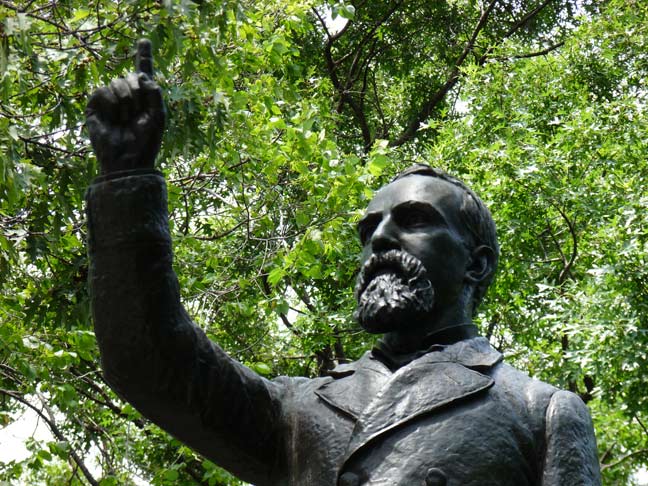 Samuel Sullivan Cox Statue — Tompkins Square Park, New York City
A statue of former Congressman Samuel Sullivan Cox rests in the southwest corner of Tompkins Square Park. He’s called “the postman’s friend” for helping postal workers secure better wages and working conditions in the 1880s and credited with contributing to the establishment of the U.S. Coast Guard. However, on June 2, 1862, a year after the Civil War began and six months before the Emancipation Proclamation, he said this, according to Alan Singer, a historian and professor of secondary education at Hofstra University and author of “New York and Slavery: Time to Teach the Truth”: “I have been taught in the history of this country that these Commonwealths and this Union were made for white men; that this Government is a Government of white men; that the men who made it never intended, by any thing they did, to place the black race on an equality with the white.”


