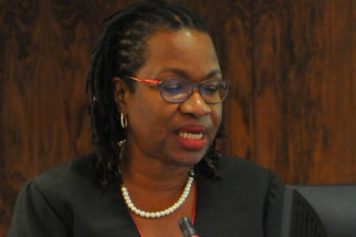
Trinidad and Tobago’s Prime Minister Kamla Persad-Bissessar (back row right) stands with other Caribbean representatives, alongside Vice President of the United States, Joe Biden (middle row left), during the Caribbean Energy Security Summit, at the State Department in Washington DC on Monday morning.
Prime Minister of Trinidad and Tobago, Kamla Persad-Bissessar, has proposed a Caribbean Energy Thematic Fund for CARICOM member states, to address regional energy security.
Speaking at the first Caribbean Energy Security Summit, which took place on Monday in Washington, DC, the prime minister reaffirmed her government’s commitment to working with the United States and other Caribbean countries in fostering a “cleaner, more sustainable energy future” in the region.
Persad-Bissessar said, “Energy is at the heart of efforts to build resilience through improved competitiveness and stronger energy security.”
She noted that resilience can be built by transforming the energy matrix in the Caribbean, which requires a three-pronged approach:
(i) improving conservation and energy efficiency,
(ii) maximizing the use of renewable energy sources and
(iii) converting to liquefied natural gas (LNG) fuelled electricity generation for the base load capacity.
The prime minister acknowledged that the cost of this solution is not supportable for countries with high debt and minimal fiscal space, and it is therefore necessary to engender cooperation for building resilience through energy security.
Persad-Bissessar proposed a methodology to work with the Inter-American Development Bank (IADB), the Caribbean Development Bank (CDB), the World Bank, the IMF and other international donors, friends of the Caribbean and the private sector to provide the method and means of achieving energy security in a considered manner that is efficient and sustainable.
She noted that the government of Trinidad and Tobago has been working in close collaboration with the IADB over the last 18 months to design a new initiative that is home-grown in the Caribbean.
“After rigorous economic analysis and technical feasibility studies and a thorough assessment of these, we have agreed as a government on the creation of a Caribbean Energy Thematic Fund for CARICOM member states,” Persad-Bissessar stated.
The target fund under discussion with the IADB will be $1 billion, with comprehensive international participation being a trigger for Trinidad and Tobago’s commitment.
The prime minister pointed out that working with traditional donors and countries with a strategic interest in the region and the private sector can provide the necessary financial and technical support to the Caribbean for bringing state of the art methods for structuring financial support to bring about the transformation of the energy sector, while at the same time maximizing public private partnerships to the benefit of people of the region.
Read more at Caribbean News Now