Cynthia McKinney
After the recent and ongoing killings of unarmed Black men by police officers, a new Atlanta-based group called the Coalition to Combat Police Terrorism is adding its voice to discussions of how police brutality has been plaguing the Black community.
Many groups have been formed specifically to help combat police brutality but there has been a recent surge in Black vigilante groups sharing more radical views on the issue.
In a country where police officers are viewed by many as heroes, the Coalition to Combat Police Terrorism cites history to make the claim that the modern police are just an extension of the Ku Klux Klan.
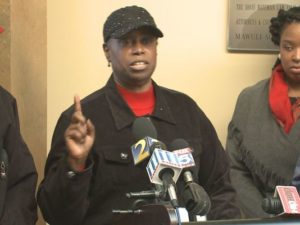
“They’re the descendants of the Ku Klux Klan,” Dhoruba bin-Wahad, a former leader of the Black Panther party and current member of the Coalition to Combat Police Terrorism, said during a news conference on Monday. “They’re descendants of the militias that used to go hunt slaves and run them down. That’s how they police our community.”
The group is led by former Georgia Congresswoman Cynthia McKinney, who is no stranger to stirring up controversy in order to fight for the Black community.
Her political career reflected her willingness to speak her mind and actively step in for the Black community where the government fell short—often pissing off white people in the process.
At the news conference she was asked if the group felt like it should show some sort of restraint following the recent killing of two New York police officers.
The killer, Ismaaiyl Brinsley, claimed the murders were to seek vengeance for Eric Garner and Michael Brown.
McKinney simply explained that the group’s mission is always a relevant one and that it will charge forward despite the circumstances.
“It’s not against police officers in general,” McKinney said at the news conference. “But it certainly is against those who use excessive force, who use the opportunity that they have to protect the community to terrorize the community.”
McKinney wanted to make it clear that she has no problem with police officers in general, especially considering the fact that her own father was an historic police officer.
Rep. Bill McKinney was one of Atlanta’s first post-integration Black police officers.
Other groups, like the Dallas-based Huey P. Newton Gun Club, are also boldly moving forward with more radical ways to address police brutality.
The group, which is named in honor of the former Black Panther leader, stages protests during which they proudly carry their own semiautomatic weapons.
The newly formed group listed multiple demands on its official website, one of which was to put a stop to police brutality.
They also view the recent killings and overall treatment of Blacks by police officers as blatant acts of terrorism.
“The recent murders of unarmed black, brown, and whites across the United States of America has eradicated trust in the police,” the group’s website states. “Individuals across the nation have been stripped of due process, subjected to state-sponsored police terrorism, and continue to suffer the fate of being terminated extra-judicially.”