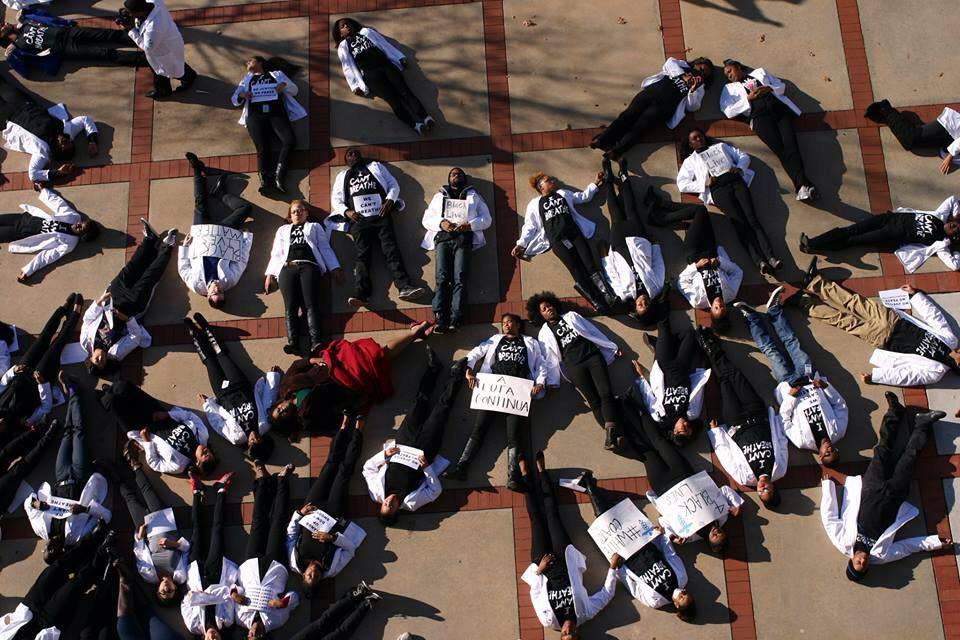
 Hundreds of medical students coordinated nationwide “die-in” protests against racial profiling and police use of deadly force with the help of the hashtag #WhiteCoats4BlackLives on social media.
Joined by others as well, medical students protested on more than 70 campuses, including Duke University School of Medicine, Emory University School of Medicine, Harvard Medical School and Howard University College of Medicine.
Trending hashtags on social media has been an effective communication tool utilized by protesters since the grand juries in Ferguson, Mo., and New York City did not indict the white officers who killed unarmed Black men. Other trending hashtags like #CrimingWhileWhite and #AliveWhile Black sparked conversations about racial profiling by police officers.
Students held signs that read “Hands Up, Don’t Shoot,” or “I Can’t Breathe,” in support of Michael Brown and Eric Garner, the Black men who died by the hands of police.
USC students pose for #whitecoats4blacklives – solidarity from medical students nationally for #BlackLivesMatter. pic.twitter.com/WqzfMYctwT
— Khaled Bey (@KhaledBeydoun) December 11, 2014
Harvard Medical School students in solidarity. #whitecoats4blacklives #BlackLivesMatter pic.twitter.com/OWl4di3zXj
— Sarah Clements (@sfclem) December 11, 2014
White coats for black lives. @ucsf #whitecoats4blacklives #BlackLivesMatter pic.twitter.com/hRFNhvPAwr
— UCSF Diversity (@UCSFODO) December 10, 2014
The demonstration by the medical students was organized by Students for a National Health Program, an affiliate of Physicians for a National Health Program (PNHP), according to The Huffington Post. The organization includes more than 19,000 members advocating for reform in the U.S. health care system.
“We feel it is essential to begin a conversation about our role in addressing the explicit and implicit discrimination and racism in our communities and reflect on the systemic biases embedded in our medical education curricula, clinical learning environments, and administrative decision-making,” according to a PNHP statement.