Protesters at St. Louis area mall
After days of stories in the Black media and widespread social media discussion announcing a Black Friday shopping boycott to protest the grand jury decision in Ferguson, retailers said yesterday that sales over the Thanksgiving weekend had plunged 11 percent compared to last year, representing a dollar dropoff of nearly $7 billion.
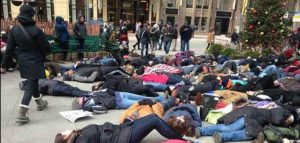
Although there were stories and images of Black protesters disrupting mall shopping in various locations and even shutting down several malls in the St. Louis area, there was absolutely no mention of the boycott in the mainstream media stories that attempted to explain the unexpected decline in holiday sales.
While lower gas prices and a stronger economy had analysts before the holiday predicting a big bump in Thanksgiving weekend sales, stories in the mainstream media after the holiday have these same analysts twisting themselves into pretzels to explain the drop in sales.
The New York Times suggested Black Friday may be waning in importance, “as retailers increasingly offer deep discounts days, and even weeks, before the traditional year-end sales period. That means many people may have simply done their shopping earlier and stayed home during the Thanksgiving weekend.”
The Washington Post similarly said the decline may be because stores are starting their onslaught of promotions even earlier than Black Friday.
NBC News curiously posited that the $7 billion decline in sales was a positive sign for retailers, possibly signaling that the holiday shopping would actually be stronger because people are less interested in “sales.”
But none of these media outlets made mention of the Black community’s boycott. Not a sentence, not a clause, not a half of a quote. It was as if the efforts of 13 percent of the population, representing more than a trillion dollars of spending power, didn’t merit a thought in serious media discussions of the holiday shopping.
Matthew Shay, chief executive of the National Retail Federation, even held a conference call with reporters to give his explanations for the holiday drop. The following statement summarizes Shay’s thinking.
“A strengthening economy that changes consumers’ reliance on deep discounts, a highly competitive environment, early promotions and the ability to shop 24/7 online all contributed to the shift witnessed this weekend,” Shay said.
The 43 million African-American consumers in the U.S. are a substantial segment of the spending public—though they are traditionally ignored or discounted by mainstream advertisers and marketers. A report last year by Neilsen revealed that Blacks watch more television (37 percent), make more shopping trips (eight), purchase more ethnic beauty and grooming products (nine times more), read more financial magazines (28 percent) and spend more than twice the time at personal hosted websites than any other group in the U.S.
Blacks make 156 shopping trips per year, compared with 146 trips for the market overall. In addition, when polled by Neilsen before the holidays, Blacks were much more likely than every other group to say they were planning to spend more this holiday season. A total of 10 percent of the U.S. population said it was planning to spend more this holiday season than last year, but that number was 17 percent in the Black community.
So if a significant portion of the most robust consumer spending group in the U.S. decided it was going to stay home this past weekend, it might have a bit of an impact on overall sales.
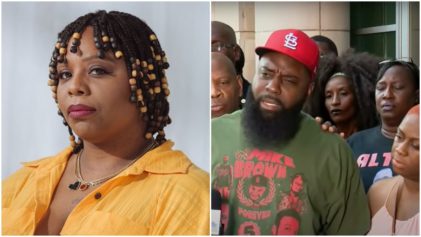
The announcement of the Thanksgiving shopping boycott first emerged early last week, coming from activists in Missouri from an organization called the Justice for Michael Brown Leadership Coalition and also in Atlanta from the African-American Leadership Council led by Rev. Timothy McDonald. The Missouri activists called the movement “No Justice, No Profit” and its intent was for African-Americans to channel their disgust and sense of helplessness after the grand jury decision not to indict Darren Wilson for killing Michael Brown into a proactive way to demonstrate their rage. Even Hollywood directors like Ryan Coogler (Fruitvale Station) and Ava DuVernay (Selma) joined the call for a boycott.
“Until this nation begins to place value on black lives, there will be no value placed on this business because Black lives matter,” coalition member Dacia Polk told St. Louis public radio.
Instead of hitting the usual spots during the heavy shopping weekend, coalition leaders urged African-Americans to spend their money exclusively with Black-owned businesses.
“We know that Black Friday can be the margin of difference of profit for many of these corporations,” the Rev. Timothy McDonald said at the Atlanta gathering, according to AJC.com. “We do not want them to profit on the back of Michael Brown, and all of the Michael Browns who came before him, and all of the other Michael Browns who will come after him.”
The percentage of consumers who shopped between Thursday and Sunday, according to the National Retail Federation, fell from 58.7 percent last year to 55.1 percent this year. That was reflected in a drop in spending from $57.4 billion last year to $50.9 billion this past weekend.
“This year is really slow, there’s a big difference from even last year,” Kmart customer service manager, Indira Reyna, 44, told the Times. “It’s never been this slow. We still have all these deals.”