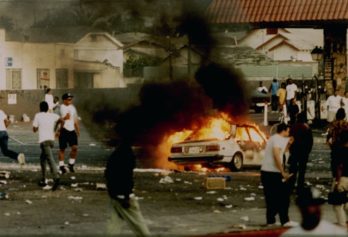
Contrary to popular belief and the one burning police car that was shown on news stations for over two hours, a lot has changed when it comes to the public’s reaction to court cases.
Take the Los Angeles riots in 1992 that came after the acquittal of four white police officers who had beaten Rodney King. If you think the Ferguson riots were chaotic, then you’re not considering that the Los Angeles riots, which took place in the nation’s second largest city, left 53 people dead.
In contrast, the Ferguson riots took place in a small, struggling community and have not yet claimed any lives. They’ve even sparked peaceful protests in Los Angeles and other major cities.
An article in The Economist makes the case that America’s problem of race is actually becoming a problem of class.
“Ferguson is stuck between the prosperous white exurbs of St Louis and the city’s somewhat revitalized centre,” an article title “Race in America: The Fury of Ferguson” points out. “In 1990 its population was three-quarters white; by 2010, it had become two-thirds black. The sub-prime mortgage crisis hit it hard. Many of its homeowners still owe more than they own.”
Solving the city’s problems of economic disparities and reworking the way the policing system works might prove to do more for the tension in the community than passing laws aiming at stopping discrimination, the article claims.
“Ferguson’s political institutions have not kept up with its demography,” the Economist points out. “Of the city’s six-member council, five are white. The hapless mayor, James Knowles, is a white Republican who was re-elected in 2013 in an election in which fewer than one in eight eligible voters turned out. He is in charge of the police force, in which three out of 53 officers are black. Such disparities feed the belief—held by blacks across the country—that both justice and law-enforcement systems are racist.”
African-Americans have made strides. Our riots are turning more peaceful and invoking more thought than violence, but in order to make steps of progress, the magazine suggests economic disparities in the country and the policing systems must be addressed.