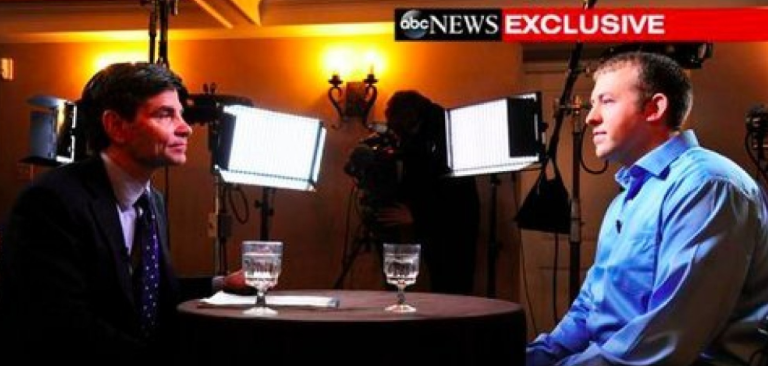
 Michael Brown’s killer, Darren Wilson’s testimony did nothing but promote the racial stereotypes that Black men face on a daily basis.
“I felt like a five-year-old holding onto Hulk Hogan,” he said in his testimony to the grand jury. “That’s just how big he felt and how small I felt.”
Wilson went on to say that “the only way” he could describe Brown’s “intense aggressive face” was that it looked like “a demon.”
His description of Brown doesn’t make sense next to his mother, Leslie McSpadden.
“My son was sweet,” she said. “He didn’t mean any harm to anybody.” She described him as “a gentle giant.”
Many observers, such as Slate’s Jamelle Bouie and Vox’s Lauren Williams, have pointed out that Wilson’s testimony sounded like a reincarnation of the “Black brute” caricatures throughout history that have portrayed Black men as savage, demonic and criminal.
These same sentiments were rampant after the Civil War when many writers argued that the only thing that had kept Black men tame for years was the institution of slavery and the harsh punishments they received.
In the Reconstruction-era novel “Red Rock,” Thomas Nelson Page wrote of a Black politician — a “repulsive creature,” Moses — who tried to rape a white woman: “He gave a snarl of rage and sprang at her like a wild beast,” according to NPR.
These polarizing feelings towards Black men aren’t just something of old, dusty books, though. Recently on Twitter, users have been using the hashtag #Chimpout to describe those protesting the grand jury’s decision. Urban Dictionary defines “chimpout” as “used to describe the bad behavior of black people, especially when they behave like animals.”
“We know dehumanization often emerges as people treating others as subhuman, like vermin in the case of the Holocaust, [or] as apelike in depictions of African-Americans in U.S. history, and that denies people humanity,” said Adam Waytz, a psychologist and assistant professor at Northwestern University’s Kellogg School of Management. “What we’re saying is that superhumanization is another way of denying humanity and ‘othering’ African-Americans by saying that they exist sort of outside the human realm.”
Waytz agreed that some of this kind of language was apparent in Wilson’s testimony.
“Superhuman strength, superhuman speed, this idea of him as a demon; this depiction of Brown as Hulk Hogan versus a child,” he pointed out via NPR.
“The other side of the superhumanization coin is you believe that black people are less sensitive to pain, and perhaps [Wilson] is suggesting that because of the superhuman nature of Brown in this moment, which he perceived, more excessive force was required.”
Police veteran and co-founder of the Center for Policing Equity and the director of community outreach, Tracie Keesee, says that of course these stereotypes affect police officers.
“We’ve always talked about those social stereotypes that go along with aggressiveness,” she told NPR. “Your mind is trying to make sense of those things in a very rapid and quick fashion. And so what we always like to train, and fashion our training around: Are you reacting to the correct thing?”