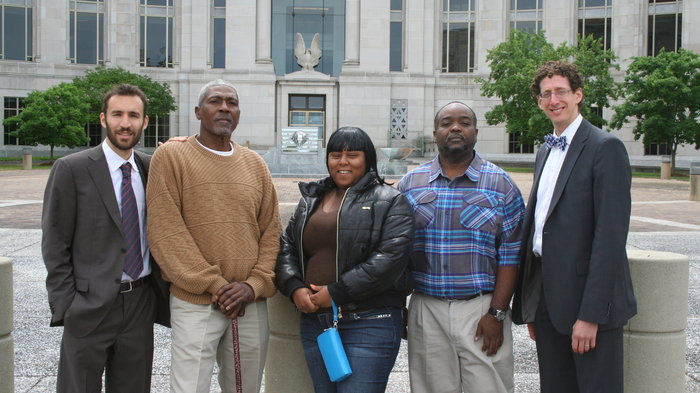
Sharnalle Mitchell (center) in Montgomery in May, after winning an injunction to stop the city from collecting court fines. With her (from left): attorney Alec Karakatsanis, fellow plaintiffs Lorenzo Brown and Tito Williams and attorney Matt Swerdlin.
Traffic tickets and other minor violations can rack up a large tab, especially if the people getting them are too poor to pay them off.
A federal court judge approved a settlement on Monday between the city of Montgomery, Al., and plaintiffs who claimed that they were unlawfully jailed when they were unable to pay their fines and fees, according to NPR.
The city agreed to set a definite standard for municipal courts to determine whether someone is “too poor” to pay court fines and fees.
Citizens of Montgomery who make less than $24,000 a year for a family of four will now be considered indigent and are allowed to pay off tickets with community service or making payments of $25 a month, according to NPR.
This settlement could set an example for cities across the nation with people who can’t afford to pay for the costs of public defenders, court ordered ankle monitors, old tickets and other costs that can add up, according to the NPR report, Guilty and Charged.
Montgomery is one of several cities that had been using private probation companies to collect payments for the city. The companies would in turn charge the people that owed the city an additional charge for them having to come collect the money.
The city agreed to stop using private probation companies to collect their fines. They also agreed to have “amnesty days” when people can get arrest warrants lifted, similar to a program being tested in Ferguson, Mo.
Single mother Sharnalle Mitchell was arrested in front of her two children on Jan. 26 in Montgomery for failing to pay old traffic tickets from 2010, according to NPR. She was sentenced to 58 days in prison for her unpaid fines. Mitchell, who cares for her 1-year-old and 4-year-old children and her disabled mother, fell behind on her payments because she makes less than $14,000 a year from working as a hair stylist, according to NPR.
“I felt like I was going to lose my kids,” she said. “I felt like everything was going down the drain.”
She counted down her days and her payments on the back of her court documents as she earned $50 a day and an extra $25 cleaning dirty jail cells to settle her $2,800 debt. She was released early after she showed her documents to Alec Karakatsanis, a civil rights attorney, according to NPR.
Karakatsanis of Equal Justice Under Law, a small civil rights nonprofit, represents Mitchell and 15 other plaintiffs in a lawsuit that claims the city “violated constitutional protections that prevent people from going to jail because they are too poor to pay court fines.” That was essentially creating a modern-day debtor’s prison.
In order to reduce the amount of arrests, the Montgomery City Council has proposed “ticket amnesty,” which will allow people to get rid of their arrest warrants and resolve their debts with a payment plan. The proposed plan should help keep non-criminals out of jail unnecessarily.
This kind of reform could provide an example for other cities like Ferguson to help their poor citizens stay out of jail. “The settlement this week has a chance to be really a groundbreaking moment in the fight against the rise of modern debtor’s prisons,” Karakatsanis told NPR.