Credit: Mike Kittrell
In a bizarre twist on the voting rights fight, Alabama officials will go before the Supreme Court this week to challenge the creation of districts with too many Black voters.
According to challengers of the state’s current district plans, Republican mapmakers in the state purposely interpreted Section 5 of the Voting Rights Act in a way that limits the power of Black voters.
Section 5 of the Voting Rights Act requires any plan to redistrict a state to be approved by federal officials to make sure that there is no “erosion in the ability of African Americans to elect candidates of their choice.”
In some states, Legislatures have crammed more Black voters into districts where Blacks already had the voting power they needed to have a fair representation in the government. The challengers say this left the surrounding districts relatively void of Black voters and allowed them to become disproportionately dominated by white voters.
In one district, mapmakers said they needed to add more than 15,000 people to bring the district up to the ideal size—and only 36 of the people were white.
This means more than 15,000 Black voters were crammed into one district and removed from surrounding districts.
According to Rep. Jim McClendon, the author of the House plan, the redistricting plans were in the state’s best interest.
“Here’s the view from 10,000 feet: About 25 percent of Alabamians are minorities, African Americans,” McClendon said, according to the Washington Post. “And about 25 percent of our legislators are African Americans. That seems like it should pass the smell test.”
A panel of three judges agreed and approved the 2012 redistricting plans with a vote of 2 to 1 and found that the legislature’s intentions were not improper.
U.S. District Judge Myron Thompson dissented from the panel’s decision, saying mapmakers should not have used racial quotas when drawing district lines.
“Race was the predominant factor in the drafter’s decisions to draw the majority-Black districts as they did,” Thompson wrote in his decision. “This is clear from an examination of the racial quotas they adopted.”
Thompson went on to say it was a “cruel irony” that Alabama is using a section of the Voting Rights Act to defend a decision that has significantly diluted the power of Black votes in the state.
The GOP has maintained control of the statewide offices in Alabama ever since the new districts were drawn and they fill all but one congressional seat.

Democrat Susan Smith (left) speaks to Murlie Johnson (right) at the Taste of the South as she campaigns for election to the state Senate
Credit: William Widmer/The Washington Post
Republican lawmakers claim that is the real reason why the challengers are opposed to the new district lines.
“This case is not about race or even civil rights issues generally,” a brief filed by Alabama House Speaker Mike Hubbard and Senate President Pro Tem Del Marsh said. “Rather it is about the Alabama Democratic Party’s loss of 136 years of uninterrupted legislative power.”
Hubbard and Marsh also claimed that Democrats “publicly touted” what they called a “perfect political gerrymander” when they controlled the legislature back in 2010 and claimed Republicans are simply doing what Democrats did years ago.
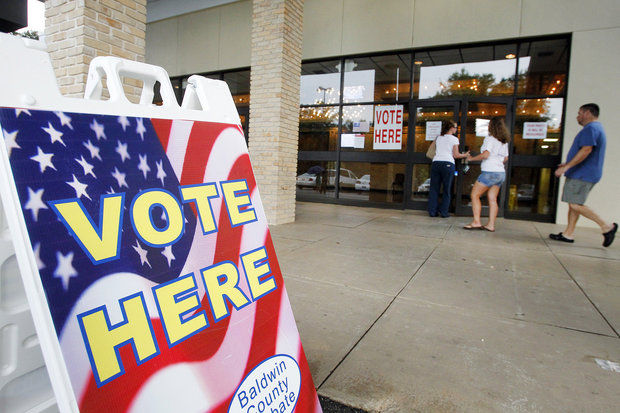
The GOP’s new boundaries will be used for the election tomorrow.
Several Democratic incumbents decided not to run after being discouraged by the new district lines that sway in favor of Republican candidates.
It will be up to the Supreme Court to decide if the new district lines need to be redrawn.