Credit: Kevin Hagen for The Wall Street Journal
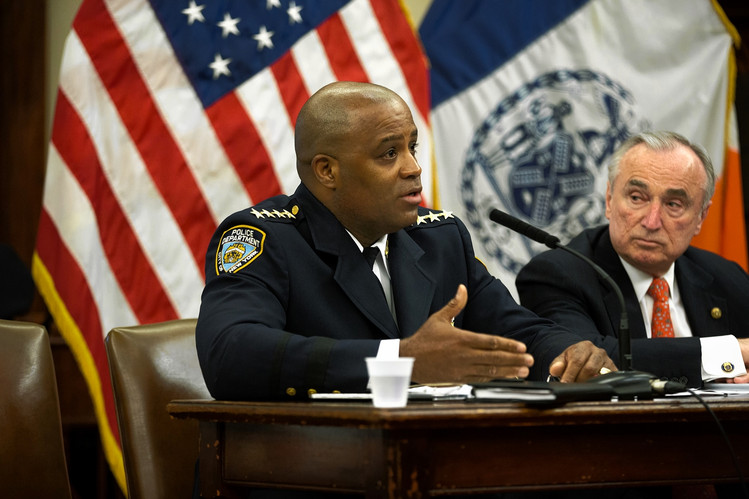
The New York Police Department is bidding farewell to its highest-ranked Black officer, Philip Banks, and lawmakers say they are “disturbed” about what that might mean for law enforcement in the city.
The NYPD has had a long history of poor relations with the Black community.
When Bill Bratton was sworn in as the head of the NYPD in January, he promised the city that he would focus on improving those relationships.
Lawmakers in New York, however, feel like Banks’ resignation could cause a lot of damage to that mission.
Banks has been with the force for nearly 30 years and, according to The Daily News, he was recently offered a promotion.
Banks allegedly turned down the promotion and claimed he was afraid of getting buried in paperwork “behind a desk.”
Regardless of what the reason may be, state Assemblyman Karim Camara, chair of the assembly’s Black, Puerto Rican, Hispanic Legislative Caucus, said the resignation is coming at an extremely “delicate time.”
“His departure from the department could not have come at a more delicate time,” Camara said in a public statement. “There was no one better strategically placed to strike the necessary balance between respecting and yet also effectively protecting local communities.”
City Council members Jumaane Williams and Vanessa Gibson released a joint statement about the resignation and explained their fear of what the NYPD might become without Banks’ leadership.
“As elected officials who have fought for better police practices, we are extremely disturbed by news of the resignation of Chief Banks,” the joint statement said. “Throughout Chief Banks’ tenure, his leadership has played a critical role in helping to navigate the difficult relationships between NYPD and communities of more color as we attempted to deal with chronic issues in policing.”
The statement went on to specifically reference the NYPD’s abuse of the stop-and-frisk policy and the “broken windows theory.”
The “broken windows theory” is the belief that harsh policing of petty offenses lands harder on minorities.
The aggressive arrest of Eric Garner, the Black man in New York who was being arrested for selling bootleg cigarettes, would be a prime example of the theory.
The July arrest led to Garner’s death after one of the officers put Garner in a NYPD-prohibited chokehold.
Other laws like pot possession and dancing in the subway are other petty crimes that are usually strictly enforced and have a major impact on people of color.
Bratton opened up to reporters about the resignation and explained that he never had any problems with Banks during his time in the force.
“We were very simpatico in the understanding that the culture of the department needed to be reshaped,” he said, referencing the need for the city’s law enforcements to patch their relationships with communities of color.
Williams and Gibson’s joint statement also claimed that the resignation only proves there is much more work that needs to be done to reform the NYPD.
“The resignation of the highest-ranking Black and Latino official in the department seems to provide a strong indication that much more work needs to be done within the NYPD,” the statement continued. “The administration must fully admit that there is a systemic issue within the NYPD that revolves around race and class in this city.”