
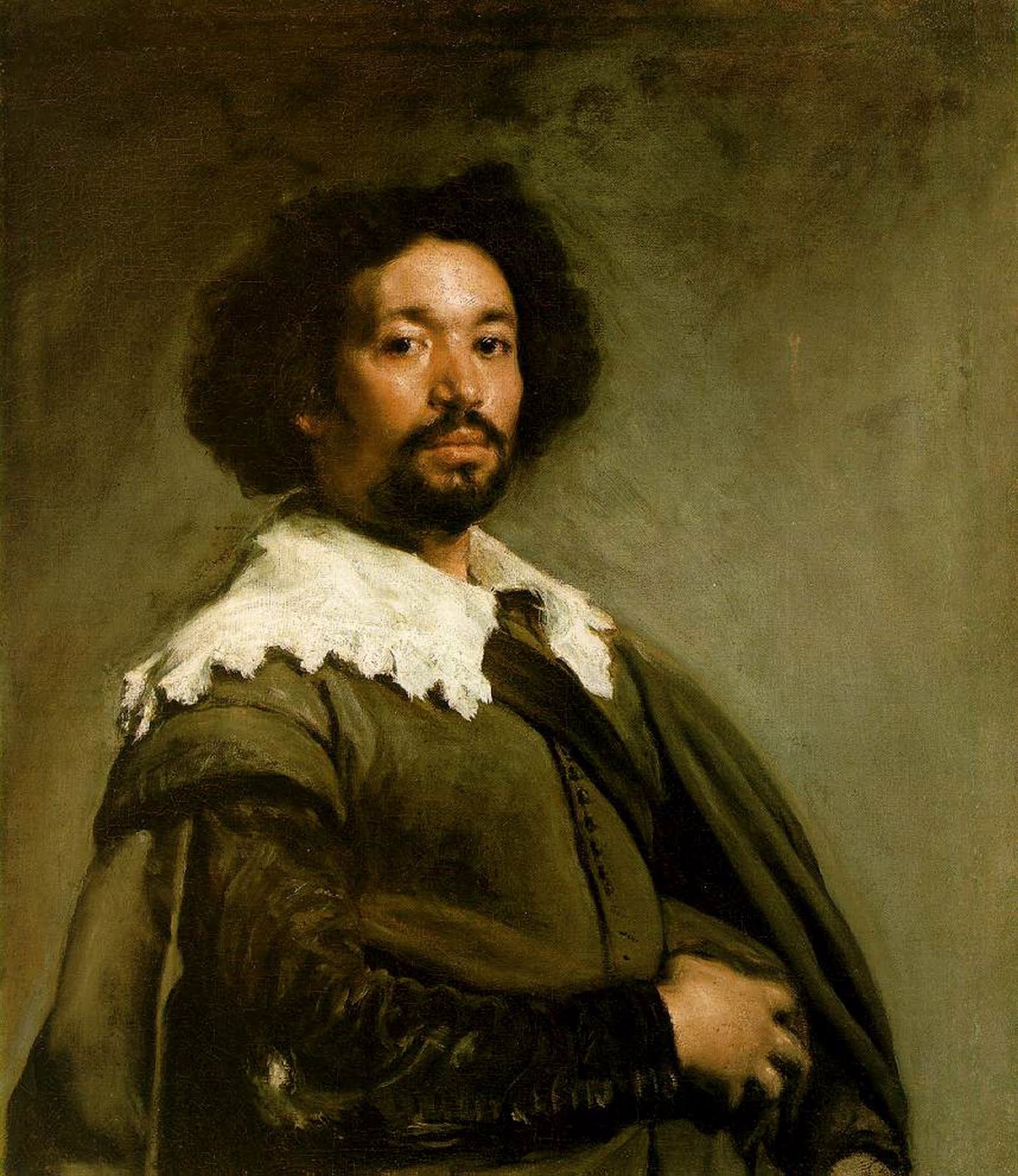
“Portrait of Juan de Pareja” by Diego Velázquez. (Metropolitan Museum of Art)
Juan de Pareja (1606–1670)
Juan de Pareja was a painter from Seville, Spain whose work “The Calling of St. Matthew” (sometimes also referred to as “The Vocation of St. Matthew”) is currently on display at the Museo del Prado in Madrid. He was described as a “Morisco,” meaning “of mixed parentage and a strange color.”
Until recently, it was believed that Pareja was enslaved by the celebrated Spanish artist Diego Rodríguez de Silva y Velázquez, and later freed. However, historians have learned that Pareja was likely a freedman prior to his arrival in Madrid because he passed the examination to be designated a painter in Seville, a profession from which slaves were legally banned.
 Juan Latino (1518–1596)
Juan Latino, born Juan de Sessa, was a distinguished African scholar at the prestigious University of Granada in 16th century Spain. He became famous for his epic Latin poems. A native of Berbería, a Spanish term associated with the Northern Coast of Africa, Latino was brought to Spain at the age of twelve.
Between 1573 and 1585, Latino published three volumes of Latin poems in which he reflected on the condition of blacks and negated the validity of any religious justification for slavery of Africans. His most famous poem is probably the “Austrias Carmen,” dedicated to Juan de Austria, the hero of the sea battle of Lepanto.

George Polgreen Bridgetower (1780–1860)
George Augustus Polgreen Bridgetower was an Afro-Polish virtuoso violinist who lived in England for much of his life. He was the son of Frederich Bridgetower, an African prince, and a Polish woman of German descent named Mary Ann.
Bridgetower made his performing début as a violinist around age nine or 10, in Paris in April 1789. The journal Le Mercure de France raved about his performance, declaring that “his talent is one of the best replies one can give to philosophers who wish to deprive people of his nation and his color of the opportunity to distinguish themselves in the arts”.

Anton Wilhelm Amo (1703–ca. 1759)
Anton Wilhelm Amo or Anthony William Amo was an African from Axim, a region in what is now Ghana, who became a respected philosopher and teacher at the universities of Halle and Jena in Germany after studying there. Amo was supposedly treated like a member of the royal family. At the University of Halle, Anton finished his preliminary studies in law within two years, titling his thesis: “Dissertatio Inauguralis De Jure Maurorum in Europa”(1729). This manuscript on The rights of Moors in Europe is lost, but a summary was published in his university’s Annals (1730).
Amo moved to the University of Wittenberg to further his studies. He studied logic, metaphysics, physiology, astronomy, history, law, theology, politics, and medicine. Amo also mastered six languages (English, French, Dutch, Latin, Greek, and German). While teaching, Amo became embroiled in bitter philosophical debates that reached well beyond the ivory tower. Authorities and critics eventually made his position so uncomfortable that he returned to Axim around 1747.

Anatole Broyard (1920–1990)
Anatole Paul Broyard was an American writer, literary critic and editor for The New York Times. A Louisiana Creole of mixed race, he was criticized by some Blacks for “passing” as white as an adult and failing to acknowledge his African-American ancestry.
Prior to 1970, Broyard published stories in several magazines. After the 1950s, he taught creative writing at The New School, New York University, and Columbia University. In addition, he also wrote daily book reviews for the New York Times. In the late 1970s, Broyard started publishing brief personal essays in the Times, which many people considered among his best work. He was among those considered “gatekeepers” in the New York literary world, whose positive opinions were critical to a writer’s success.
 Carol Channing (1921–2019)
Carol Channing was a legendary Broadway performer. Her earlier roles on Broadway included “Proof Thro’ the Night” and “Lend an Ear,” but she became well-known after starring in “Gentlemen Prefer Blondes” in 1949. The performer, known for her smile and raspy voice, won a Tony Award for “Hello, Dolly!” and a Golden Globe for her role in “Thoroughly Modern Millie.”
Channing was been celebrated as another glamorous white star until she shocked the world with her 2002 autobiography in which she revealed her father was actually a biracial Black man.


