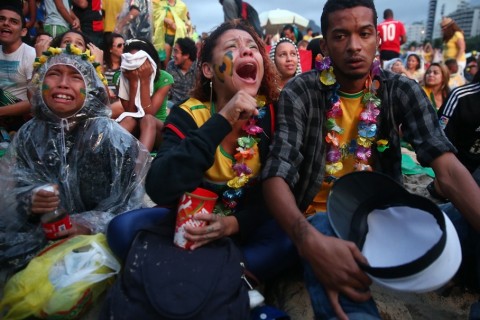
 Daniel Pereira went to work on Tuesday in Sao Paulo, Brazil, because he could not bear to stay home and watch.
“We’re nervous, but we have to control our emotions,” Pereira, 33, a hotel clerk, said before the Brazil-Germany match kicked off 400 miles away in Belo Horizonte.
“It will not be understandable,” Pereira said when asked if Brazil would be forgiving in defeat. “They have to win. We are playing in our country and they are fighting for our nation.”
Everyone knew it would be difficult for Brazil without the injured star Neymar and the suspended captain, Thiago Silva, but nobody imagined this feeble capitulation—four goals surrendered to Germany in six minutes during a 7-1 rout in a World Cup semifinal.
Early on, Brazil’s players bickered, lost their cool, then lost their fight. The country of the beautiful game was left to face a grotesque humiliation.
Luiz Felipe Scolari, the coach, flung his hands in disgust amid the flurry of early German goals. Marcelo, a defender, put his hands to his face in embarrassment and disbelief. A boy and a woman cried in the grandstand beneath their glasses, appearing stunned and overcome on camera.
No country is more closely associated with soccer than Brazil. None have won more World Cup titles than Brazil’s five. None have so feverishly demanded style with victory. None could be more stricken by such total and bewildering defeat.
“We ask for forgiveness,” Scolari said.
Everything was lost for Brazil on Tuesday, even the World Cup scoring record, once held by Ronaldo, now in the possession of Germany’s Miroslav Klose, with 16 career goals.
Not since Ronaldo’s unexplained malaise in the hours before a 3-0 loss to host France in the 1998 World Cup final — a panic attack? a seizure? — had Brazil encountered such baffling incapability.
It is one thing to be chastened on another continent, quite another to be shamed at home. Not that it is ever easy to win a World Cup on home soil. Ask Italy about 1990. Ask Germany about 2006. Yet Brazil faced a particularly fraught task — to win before a nation that widely questioned whether the World Cup was a waste of money, yet expected the Seleção to uphold their honor on the field.