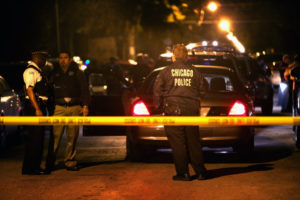
 The arrival of hot weather has brought a familiar scene to Chicago: another spate of gun violence, with the Fourth of July weekend seeing 82 people shot and 14 dead.
Six of the shootings involved Chicago police, who killed two people who allegedly were armed, according to police officials — though in one case, family members don’t believe the police story.
It’s been several years since the city first exploded with widespread violence seemingly coming every weekend, though officials have claimed the extent of the violence is exaggerated and are touting a record-low number of murders. There have been 1,129 people shot so far this year. Last year, there were 2,185 shootings victims for the entire year. So this year’s pace is about even with last year’s.
One Saturday shooting occurred when police were reportedly pursuing 16-year-old Warren Robinson. Police said the teen “turned and pointed a weapon in the direction of the pursuing officers. Fearing for their lives and the lives of their partners, officers discharged their weapons.”
But the teen’s family says witnesses told them they saw Robinson raising his hands in surrender when police opened fire.
“He didn’t have a gun on him,” Robinson’s mother, Georgina Utendahl, told ABC Chicago. “I have witnesses who saw him running from other people and police shot him.”
In a Friday shooting, police approached a man drinking on a porch who they say had a suspicious object in his waistband. When they attempted to question him, he ran away, and police claim he aimed “a large revolver at the officer.” This prompted police to open fire, killing the man.
Other shootings in the city included: a 24-year-old who died of multiple gunshot wounds in the middle of a South Side block; an unknown 44-year-old woman who was shot and killed as she leaned on her car; a 23-year-old man who was shot to death sitting on a friend’s front porch; and a 21-year-old who was shot in the head while sitting in a car with a teenage friend.
“With these kind of numbers in Chicago, from the White House on down to the city, there should be a response: What do we do? How do we stop this?” said Father Michael Pfleger of Chicago’s South Side St. Sabina Catholic Church.
“While to date we have had the fewest murders since 1963, one victim is too many, and there is clearly much more work to be done,” police spokesman Martin Maloney said, according to CBS Chicago. “We will keep building on our strategy, putting more officers on the street in summer months, proactively intervening in gang conflicts. Yet, even with the best police and the best policing strategy in the world, without better state and federal laws to keep guns off the streets and out of the hands of dangerous criminals, we’ll continue to face an uphill battle.”
While the city’s Independent Police Review Authority was investigating the police-involved shootings, the Chicago Police Department released the following statement: “Officers do not relish using a weapon in the course of their work, but … they must do what is best to protect themselves and the public they serve.”