Numibia (202 B.C. – 46 B.C.)
 Numidia was another great Black Berber-Libyan nation in northern Algeria during the time of the Romans and Carthaginians. It began as a sovereign state, and later alternated status between Roman province and Roman client state. It is considered to be the first major state in the history of Algeria and the Berber world.
Numidia has also been classified by European and Arab historians as a Caucasian- or Semetic-built civilization. However, in his book, The Destruction of Black Civilization, Chancellor Williams declared that Libya was once so nearly all-Black that to be called a Libyan meant that one was Black.
The Greek historian Herodotus, writing about Libya in his Histories (Book Four), stated:
“One thing I can add about this country: so far as one knows, it is inhabited by four races, and four only, of which two are indigenous and two are not. The indigenous peoples are the Libyans and Ethiopians, the former occupying the northerly and the latter the more southerly parts; the immigrants are the Phoenicians and the Greeks.”
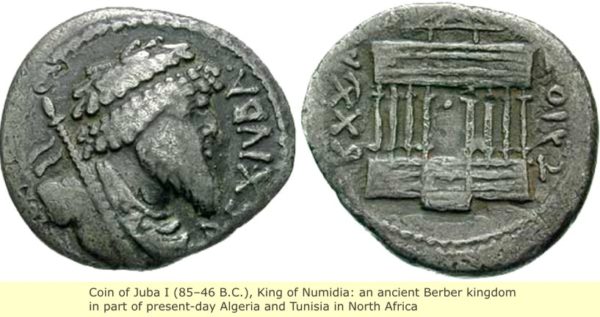
One of the most famous Berber-Moors of the Roman times was Masinissa, the king of Numidia (238-148 BCE), who assisted the Romans against the Carthaginians during the Punic Wars.
The coin depictions and statutes of King Masinissa confirm without doubt, that this great Berber leader and king of the Moors was phenotypically a Black African man with woolly hair (similar to the West African type). Syphax, king of the Masaesylians in Numidia, a contemporary and great rival of King Masinissa, was also depicted in his coinage as a phenotypically Black African.