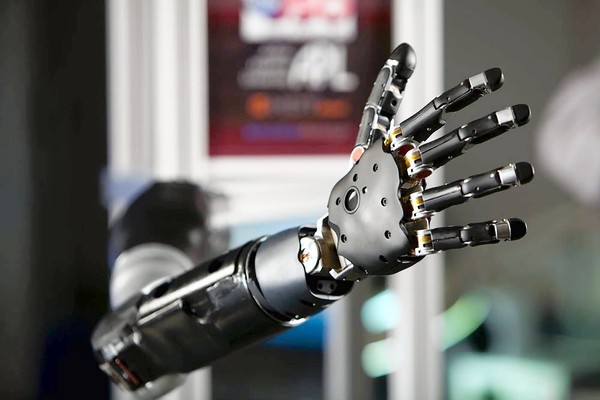
 Nearly eight years ago, DARPA, the U.S. Defense Department’s advanced research agency, set out to find a better solution for amputees than the metal hooks still widely used today. Now, the Food and Drug Administration has granted its approval to one of the projects that came from that effort: a mind-controlled prosthetic limb called the DEKA Arm. A number of other scientists and engineers around the world are working on similar devices, but this is the first such prosthetic to get FDA approval. The prosthetic device comes from a company founded by Segway inventor Dean Kamen, and it is roughly the size and weight of an adult arm.
The arm is controlled by electromyogram electrodes placed on the remaining portion of the human arm. Those sensors pick up electric signals from muscle movements in the upper arm, and a computer in the robotic arm can tell what type of maneuver the user wants to make. The results are impressive. With the arm, amputees in clinical trials were able to perform tasks once thought impossible for a prosthetic limb. They could use zippers and keys, and — thanks to vibration feedback at the base of the prosthetic — they could pick up objects like grapes and eggs without crushing them.
The FDA is calling the DEKA Arm the first prosthetic arm controlled by electric signals that can accomplish multiple, robotically powered movements at once. To get there, DARPA has invested some $40 million into the project, according to Bloomberg Businessweek, and that’s just part of the agency’s larger $100 million “Revolutionizing Prosthetics” program. Now that the arm has FDA approval, DEKA can seek out a manufacturer and eventually get the product out to amputees. As if the capabilities of the arm weren’t enough, it seems the company already has a good marketing plan: Employees affectionately call the arm “Luke” after the “Star Wars” hero who receives a perfect arm replacement in “Empire Strikes Back.” Thankfully for amputees, a prosthetic with near-natural movements is no longer science fiction.
source:theverge.com