The Dominican Republic is a country on the island of Hispaniola in the Caribbean region. The western three-eighths of the island is occupied by the nation of Haiti. The first captive Africans were sold as slaves through the ports of Santo Domingo, Dominican Republic, in 1503. Unlike on other Caribbean islands, the Spanish invaders found that many natural resources had already been exhausted. So livestock became important in Santo Domingo and did not require much slave labor. However, with the French occupation on the Haitian side of the island, a booming sugar industry was established. Hundreds of thousands of enslaved Africans were imported to work the sugar cane plantations of Haiti.
Dominican Republic’s Independence Day
Feb. 27, 1844, marks the day that Haitian military retreated its 22-year military occupation in the Dominican Republic. One hundred seventy years later, Feb. 27 is still celebrated as the Dominican Republic’s Independence Day.
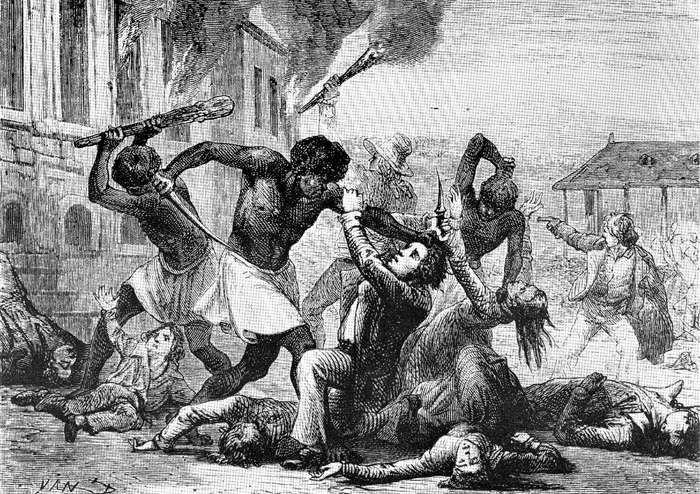
In 1822, liberated Haitians invaded their neighbors, the Dominican Republic, to free slaves there in an effort to create Black sovereignty across the island. During the occupation of Santo Domingo, the Haitians drastically limited the Catholic Church’s influence by confiscating church property, deporting the foreign clergy and severing ties to Rome. The widely Catholic Dominican population was greatly insulted by what seemed to be attacks on their religion. Hatred for their Haitian neighbors swelled.
Despite the military occupation that led to the liberation of Dominican slaves, Independence Day celebrates the evacuation of Haitian military, not a reprieve from the grip of colonialism that still lingers today. Presently, many Dominicans refer to Spain as their motherland and not Africa. Catholicism is still the predominant religion practiced throughout the country.
Still independent.
We hope this story was worth your time. For over 14 years, Atlanta Black Star has stayed Black-owned and independently run. We didn't get here by waiting on ad budgets that were never built to prioritize us. Our readers did that.
Corporate support for Black media has always been thin. Outlets like ours get roughly 1% of the $170 billion spent on U.S. advertising each year, and that margin is shrinking further as advertisers walk back the DEI-linked commitments they made in 2020. That's the backdrop. It's not why we're asking.
The wider picture isn't any steadier. Newspaper ad revenue has fallen more than 80% since 2005, and local newsrooms are closing at a rate of roughly two a week nationwide. When outlets go under, it's rarely the ones built to center a Black perspective from the ground up that get to stick around.
We know a request for support isn't why you came here. But without readers choosing to fund this work directly, the depth of reporting we can do at home and abroad shrinks along with everyone else's. If you're not in a position to give, that doesn't change how much we value you as a reader.
If you are able to, a recurring contribution does more for us than a single one-time gift, because it lets us plan the next investigation instead of just the next invoice. It takes about 30 seconds, no long form, no account. Thank you for continuing to support independent journalism and freedom of the press.