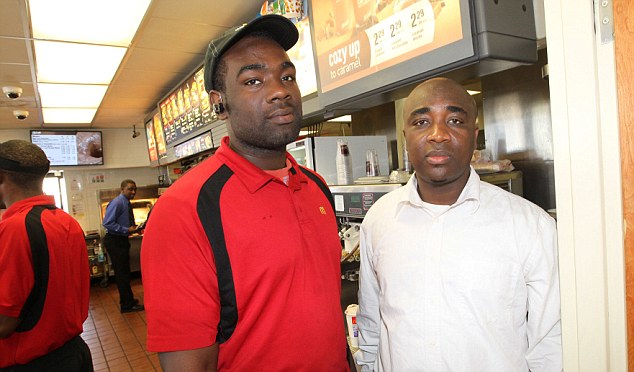
Two former McDonald’s Corp. store managers, assisting with a campaign to raise pay for fast-food workers, said they helped withhold employees’ wages at the restaurant chain after facing pressure to keep labor costs down.
The ex-managers, who came forward as part of an effort backed by worker advocacy group Fast Food Forward, said they engaged in tactics such as asking employees to continue working after they clocked out or adding unpaid breaks to time sheets. They took the steps to avoid exceeding a store’s strict goals for wage expenses, said Lakia Williams, a former assistant manager at a McDonald’s in Charleston, South Carolina.
“There was so much pressure,” she said in an interview. “It’s not only the franchisees group and the general managers, it is corporate. It’s something internal, it’s something deeper, and it’s something that has been going on for years.”
Williams said she would ask employees to work for an hour or two after they clocked out. She needed them to help clean up after a busy day and would usually give them $20 of her own money to compensate, Williams said. Kwanza Brooks, a manager who worked at McDonald’s stores in North Carolina and Maryland, said she amended time sheets to keep labor costs down.
In response to the ex-managers’ comments, McDonald’s said it takes action to resolve pay concerns in its company-owned restaurants and trusts its franchisees to do the same.
“McDonald’s and our independent owner-operators share a concern and commitment to the well-being and fair treatment of all people who work in McDonald’s restaurants,” Heather Oldani, a spokeswoman for the Oak Brook, Illinois-based company, said in an e-mailed statement. “Whether employed by McDonald’s or by our independent owner-operators, employees should be paid correctly.”
The new allegations follow a wave of lawsuits in March claiming that McDonald’s workers were being idled without pay for minutes and hours at work during slow periods, in violation of U.S. and state labor laws. Some workers also allege that McDonald’s requires them to pay for their uniforms, driving their pay below legal minimums. On the day the lawsuits were filed, McDonald’s said it was reviewing the allegations and would take necessary actions.
Read the full story at bloomberg.com