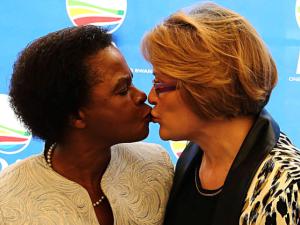
Ramphele and Zille share a kiss
One of South Africa’s most important leaders, 66-year-old Mamphela Ramphele, did an abrupt about-face and dissolved her much-publicized partnership with South Africa’s most prominent opposition white party, Democratic Alliance (DA). The community doctor who once worked alongside freedom fighter Steve Biko was slated to run against Jacob Zuma as DA’s first Black presidential candidate.
A week after Ramphele and DA leader Helen Zille, her long-time friend, announced their historic partnership with kisses and smiles, the pairing dissolved in acrimony and angry press statements, after Zille accused Ramphele of reneging on the agreement.
Ramphele led the grassroots resistance against white minority rule in the 1970s alongside Biko—the father of her children and with whom Zille also had a close relationship. Zille was the first journalist to report that Biko had died in custody. After apartheid was dismantled, Ramphele went on to become a director of the World Bank, a vice-chancellor at the University of Cape Town, and until recently sat on the board of a major mining company.
With charges of corruption against Zuma, in addition to the recent violence against South African miners and the struggles of the country’s poor, there is widespread dissatisfaction with the leadership of Zuma and his ruling African National Congress (ANC).
A year ago, Ramphele launched Agang, her own political party, but it has fallen into bankruptcy and a month ago was unable to pay its staff. Agang means “let us build” in the Sesotho language.
When the deal between Ramphele and DA was announced, Ramphele said: “We are going to take away the excuse of race and challenge the ANC to be judged on its performance. We are taking away that race card and putting it in the dustbin.”
At the time, the ANC responded that Zille and the DA was just using Ramphele because of her skin color, in attempt to erase its history as a party hostile to Black interests.
“It’s a rent-a-leader and rent-a-black face,” Gwede Mantashe, the ANC’s secretary general said.
But it soon all fell apart.
“Dr. Ramphele reneged on the agreement that she stand as the DA’s presidential candidate, and that Agang SA’s branches, members and volunteers be incorporated into the DA,” Zille said in a statement.
After the kisses of the week before, Zille angrily accused Ramphele of saying one thing to the media, another to her Agang supporters, and yet another to the DA.
“Dr. Ramphele has demonstrated, once and for all, that she cannot be trusted to see any project through to its conclusion,” she said.
In response, Ramphele said via Twitter: “There was no confusion. I remain committed and still am the leader of Agang SA. The focus was to work together in the election.”
According to media reports, the members of Ramphele’s own party, Agang SA, angrily complained that they had not been informed. Ramphele issued a statement Friday publicly contradicting the DA’s claim that she would accept its membership and insisting she is still leader of Agang SA.
“Since Tuesday’s announcement, Dr. Ramphele has been playing a game of cat and mouse,” Zille said. “It is not clear what her objective is, but whatever it is, it is not in the interests of the South African people.”
Eusebius McKaiser, author of the new book “Could I Vote DA?”, said the DA had been “panic stricken” and “tried to pull a fast one” over voters by parachuting in a Black candidate.
“It’s a demonstration of what happens when you make a hasty decision without due diligence,” he told the Guardian. “It was a massive and avoidable political blunder on the part of the DA.”
The whole matter is likely to be a big help to the ANC, which, while seen as assured of victory, is facing its toughest election yet when South Africans go to the ballots as soon as April.
McKaiser added: “For the ANC it’s a gift. The embarrassment speaks for itself. Mamphela Ramphele’s reputation is in tatters. The DA has been anxious to get a Black African face irrespective of whether it’s the right person.”