A gap in the Affordable Care Act has left almost 5 million Americans uninsured after a large number of Southern states decided not to expand Medicaid.
The Affordable Care Act, also referred to as Obamacare, has a cruel trick up its sleeve that has forced some Americans to break down in tears at their medical centers.
After a long battle with the Republican Party over passing the Affordable Care Act, legislatures decided to compromise by leaving the expansion of Medicaid up to the individual states.
Since then, more than 20 states have decided not to accept Federal funding to expand Medicaid.
The compromise also included that the Affordable Care Act would offer tax credits for private health plans that are being sold through the law’s health insurance exchange marketplaces.
The issue, however, is that these private plans are only available to Americans who are making between the poverty level and four times that amount.
For an individual, the poverty level is $11,500. What this means is that any person earning less than $11,500 a year will find themselves in a very unfortunate situation.
Families who rely on unemployment benefits particularly are up for risk as well as retired individuals who may not have had the retirement plan they dreamed of.
In Florida alone about 764,000 adults will have to go without insurance because they couldn’t quite meet the $11,500 requirement for health care or a tax credit.
“We’ve had people break down in tears at our desk,” said Jason Connor, who is under contract with community health care centers in Florida to assist with the Affordable Care Act outreach and enrollment activities. “Folks are frustrated and they’re angry, and they’ll curse at you even though have nothing to do with it.”
 While many people are pointing fingers at the president for yet another catastrophe in his health care plan, one Florida man believes the state governments need to be held accountable as well.
Marc Alphonse is an unemployed 40-year-old Marine veteran who is essentially homeless and uninsured under the Affordable Care Act.
Alphonse is currently living off of $400 every month from unemployment benefits while his wife and three children are living with relatives.
Alphonse, on the other hand, is hopping from couch to couch trying to get back on his feet. Not being able to get health care is just another major problem to add to his woes.
“It’s very frustrating,” Alphonse said. “It’s kind of odd where an individual that has an opportunity to help millions of people in their own state, and they just totally refuse to do it.”
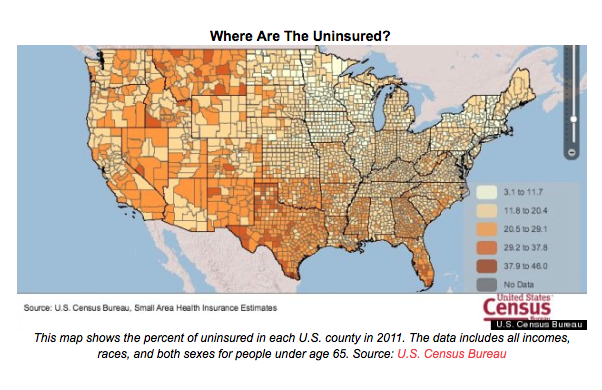
One-quarter of Florida’s population younger than 65 are currently uninsured. A record high that comes in just behind Texas for the amount of uninsured citizens.
For now, many citizens are forced to focus on surviving instead of living the American dream.
“It’s extremely scary, but I try not to think about it,” Alphonse said. “I just try to live every day because it’s what you have to do to survive.”