 A bipartisan group of lawmakers introduced the Voting Rights Amendment Act of 2014 on Thursday, which would address some of the major loopholes in the current Voting Rights Act of 1965.
The Voting Rights Act was created in order to ensure that all U.S. citizens were given equal opportunities to vote, but about six months ago the Supreme Court struck down a major part of the historical legislation.
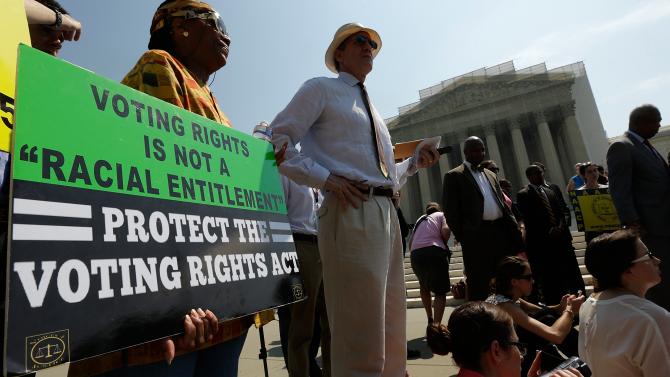
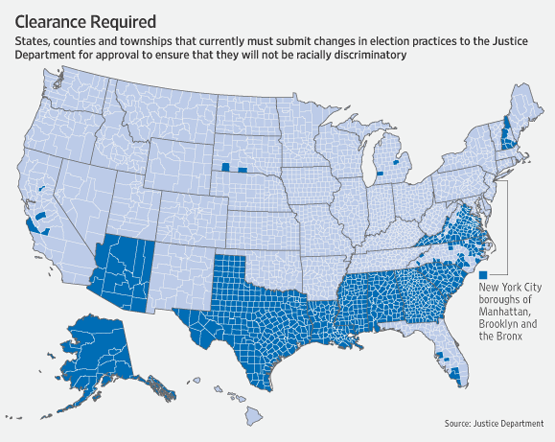
A divided Supreme Court ruled that Section 5 of the Voting Rights Act, which required Southern states to get federal approval to change or add any voting laws, was unconstitutional.
Now Wisconsin’s Republican representative, James Sensenbrenner, and Michigan’s Democratic representative, John Conyers, have sponsored a new bill that will subject all states to federal oversight if they have a certain number of voting rights violations.
Under the new bill, any state with five or more voting rights violations in the past 15 years would have to get federal approval to change or add any new voting laws moving forward.
Individual counties or townships may also be reviewed and subjected to federal oversight if the municipality has a certain number of voting rights violations.
Another new provision would require the states to provide sufficient public notice of any changes to the voting laws or changes in district lines and to give voters an early warning so that they may be able to adjust to the changes.
 The amendment will also eliminate a current provision of the Voting Rights Act that requires the courts to prove that voting rights laws in a state were intended to discriminate against certain voters.
Proving intent has always been one of the biggest challenges for legal cases over discrimination.
While proponents of the bill think it serves as a good start toward protecting voters’ rights, there are still some bugs that need to be addressed.
Under the current guidelines, states like Georgia, Texas, Mississippi and Louisiana would be subject to federal oversight.
North Carolina, a state that has passed several troublesome laws regarding voting rights, would not have to get federal approval of any new voting laws under the new bill.
Why? Because the new bill doesn’t count voter ID laws as violations.
“The exclusion of North Carolina is especially egregious, considering the flood of harmful voting policies from the state,” said Penda Hair, co-director of the Advancement Project. “These measures include a 2012 redistricting plan that diluted the power of African-American voters; the passage of a voter suppression law that cut early voting by a week, eliminated same-day registration, and requires strict voter ID, among many other restrictions.”
Hair also expressed concerns about North Carolina’s 12th Congressional District that will be without representation for 300 days after Gov. Pat McCrory decided to further postpone the election to fill the seat of former Rep. Mel Watt.
Other concerns that have been voiced regarding the new bill are that it “does not go far enough in protecting language minorities or voters living in states with restrictive voter ID laws” and that it allows for “reasonable” voter ID laws without actually defining the terms of what would be considered “reasonable.”