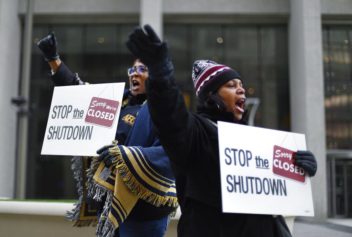
Adjustments to the budget are being made in drips and drabs, as the federal government shutdown has created more awkward moments for elected leaders.
On Wednesday, the Pentagon and Congress worked to restore death benefit payments to military service families – one of many unintended consequences of the shutdown, which entered its 11th day on Thursday.
The Pentagon reportedly reached an agreement with Fisher House Foundation, a nonprofit organization, to receive $100,000 to cover the delayed death benefits. The House of Representatives voted unanimously to restore the benefit and sent the deal to the Senate.
That follows action earlier in the week to bring back nearly all 350,000 Defense Department civilian employees who were furloughed in the shutdown.
There were questions last week whether all furloughed federal workers would receive back pay when they finally returned to work.
Last week, it appeared that essential civilian personnel would be required to work and would be paid retroactively once Congress approved a funding bill. What was unclear was whether other furloughed civil servants would be made whole once funding was restored.
These shifts indicate, perhaps, that the Obama administration and Congress realize that the impact of the shutdown reached deeper and wider than even they could have imagined. As a result, the awkward beginnings of the negotiation dance have begun, to ease the pain and the political fallout sure to follow.
Call it the new Trickle Down effect.
According to CBS News, a new Associated Press–GfK survey on Wednesday revealed 62 percent of adults surveyed online, mainly blame Republicans for the shutdown. A Washington Post/ABC poll on Tuesday which showed 70 percent of Americans disapproving of how the GOP is handling the budget negotiations, compared to 61 percent for Democrats and 51 percent for Mr. Obama.
“The president’s poll numbers aren’t exactly rosy, either,” CBS reported. “Fifty-three percent of those surveyed in the AP poll disapproved of his job performance; only 37 approved. But Congress takes the cake on public disappointment with a mere 5 percent approval rating.”
For sure, there’s enough blame to go around, but really bad poll numbers may finally be the incentive to get both sides to sit down and work things out.
Jackie Jones, a journalist and journalism educator, is director of the career transformation firm Jones Coaching LLC and author of “Taking Care of the Business of You: 7 Days to Getting Your Career on Track.”