 As the U.S. government shutdown and the looming showdown over the debt ceiling threaten to derail the fledgling recovery, a report released today showed a slight increase in the number of people filing first-time claims for unemployment insurance, while U.S. businesses added 166,000 new jobs in September.
The payroll firm ADP, which released the jobs report, described the U.S. job recovery as “softening.”
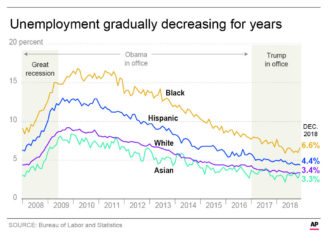
In August, the economy added roughly the same number of jobs — 169,000 — which resulted in an unemployment rate of 7.3 percent. The rate for African Americans in August jumped up from 12.6 percent to 13.3 percent, according to figures released by the U.S. Labor Department.
There were 308,000 first-time claims for unemployment insurance filed last week, up 1,000 from the week before, according to a report by the Employment and Training Administration.
The 308,000 unemployment insurance claims are running at a relatively low rate that until recent weeks hadn’t been seen since the spring of 2007 — six months before the start of the 2007-09 recession.
According to Reuters, it is “a signal of growing strength in the labor market.”
Mark Zandi, chief economist of Moody’s Analytics, ADP’s partner on the report, said: “The job market appears to have softened in recent months. Fiscal austerity has begun to take a toll on job creation. The run-up in interest rates may also be doing some damage to jobs in the financial services industry. While job growth has slowed, there remains a general resilience in the market. Job creation continues to be consistent with a slowly declining unemployment rate.”
Because of the government shutdown, the Labor Department had to postpone its job report this week. Economists had been expecting the economy to add 175,000 to 185,000 jobs to its nonfarm payroll figure in September. Economists are afraid that the budget wars threaten to hamper the recovery. If the impasse causes the U.S. to fail to raise the debt ceiling, PNC bank’s chief economist Gus Faucher has warned it could “all but wipe out” the U.S. recovery.
For more than a generation, ever since the Bureau of Labor Statistics started compiling a racial breakdown of unemployment data, the rate for African-Americans has been double that of whites, or very close to it. No matter who has occupied the White House, that phenomenon hasn’t much changed.
In June, the jobless rate for black teenagers peaked at 43.6 percent, compared to 20.4 percent for white teenagers. But the percentage of black teens with jobs increased slightly in August from the 28.7 percent in August of last year. There has been a persistent 10-point gap between the percentage of teens who have jobs and the higher number of teens who are looking and unable to find work.