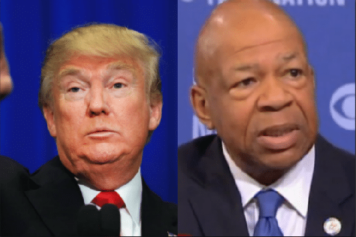
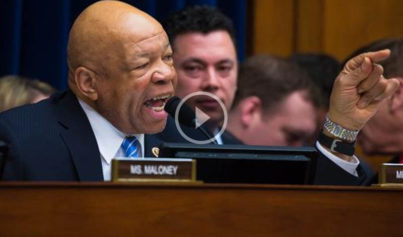
Rep. Elijah Cummings, D-Md., the top Democrat on the House Oversight Committee, presented more evidence to his claim that the White House didn’t target Tea Party groups for extra IRS scrutiny. He released IRS documents showing that progressive groups — including groups affiliated with the Occupy Wall Street movement — were also placed on an IRS “watch list” and given secondary screenings for their tax-exempt status.
Cummings said the new documents “raise serious questions” about the inspector general’s report in May that first disclosed the scope of an IRS program to target political groups.
The documents include a PowerPoint presentation and minutes from an IRS workshop on July 28, 2010, instructing agents to flag applications for tax-exempt status from “progressive” groups as well as those with “Tea Party,” “patriot” or “9/12” in their names. In addition, another document shows that “Occupy” groups were later added to a list of organizations to receive extra scrutiny.
Cummings released an email showing that after the inspector general examined 5,500 e-mails from IRS employees in Cincinnati, he found no evidence that the Tea Party targeting described in the May 14 report was politically motivated.
“The e-mail traffic indicated there were unclear processing directions and the group wanted to make sure they had guidance on processing the applications so they pulled them. This is a very important nuance,” said a May 3 email from the deputy inspector general for investigations.
Cummings said those conclusions were edited out of the final report. He wants to know why.
Cummings said the documents “directly contradict numerous public accusations by congressional Republicans that the White House and other administration officials targeted Tea Party organizations for partisan political reasons.”
He wants the Oversight Committee to bring the inspector general back next week “to explain why he failed to disclose this critical information.”
In his testimony, J. Russell George, the Treasury Inspector General for Tax Administration, has said repeatedly there was no evidence of political motivation.
But he called the report an “audit,” not an investigation, and said the report wasn’t designed to answer the questions of why the targeting occurred.
But Congressional Republicans still insist the documents show Tea Party groups were indeed given more scrutiny.
“These documents, once again, refute misleading attempts to equate routine scrutiny of other groups involved in advocacy to the systematic scrutiny of Tea Party groups by IRS officials,” said Frederick Hill, a spokesman for Rep. Darrell Issa, R-Calif., the chairman of the House Oversight Committee. “As has been documented, while 100% of Tea Party applications were systematically stopped and scrutinized for a 27-month period, at the same time dozens of progressive applications were approved by the IRS.”
Last month, Cummings released the full transcript of the congressional interview of an IRS employee during the investigation into whether the White House orchestrated greater scrutiny of tax-exempt applications from Tea Party-connected groups.
Cummings said the allegations against the White House were ridiculous and he had the interview transcripts to prove it—particularly the transcripts of an interview with a self-described “conservative Republican” from the Cincinnati office of the IRS that was responsible for scrutinizing the Tea Party applications.
While Issa, who has been implying that the interviews prove White House involvement, warned Cummings that he shouldn’t release the transcripts, Cummings ignored him—reportedly infuriating Issa.
Cummings and Issa are the highest-ranking members of the House Oversight and Government Reform Committee.
“He is a conservative Republican working for the IRS. I think this interview and these statements go a long way toward showing that the White House was not involved in this,” Cummings said, after he saw the interview transcript. “Based upon everything I’ve seen, the case is solved. And if it were me, I would wrap this case up and move on.”