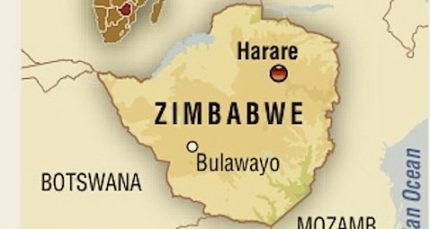
Counting is ongoing in Zimbabwe as officials tally the results of an election held Saturday on the country’s new constitution.
The constitution introduces presidential term limits, grants parliament more power and expands women’s rights — but it doesn’t stop President Robert Mugabe, 89, who has been in office since independence in 1980, from running again. Backed by Mugabe’s Zanu-PF party and the rival Movement for Democratic Change (MDC), the constitution is expected to pass easily.
As the counting began, on Sunday the government arrested three senior officials of the MDC for reasons unknown.
Zimbabwe made worldwide news in January, when the finance minister made the admission to journalists that after the government paid its civil servants, it had just $217 left in its bank accounts.
But after that scary news quickly spread around the world, Finance Minister Tendai Biti said the news stories distorted the point he was trying to make. He said he was just making it clear that Zimbabwe could not afford the $106 million it would cost for new elections — not that the country was completely broke. He said the day after the account hit $217, the country received $30 million in payments.
“You journalists are mischievous and malicious. The point I was making was that the Zimbabwean government doesn’t have the funds to finance the election, to finance the referendum,” he said. “To dramatize the point, I simply made a passing reference, metaphorically, that when we paid civil servants last week on Thursday we were left with $217… but even the following day we had $30 million in our account.”
But his last point was lost on much of the world community, which ran with the story about the insolvent African country and turned it into a joke, with bloggers writing posts advising the government on how to live on $217.
“The biggest problem with all the ‘fiscal cliff’ struggles and debt haggling had been the sheer volume of money we were talking about. Billions? Trillions? At a certain point, it all becomes vanishingly remote,” wrote Alexandra Petri, in a blog for The Washington Post that was typical. “I have no idea what you should do with $1 billion … I have never been in a position to advise a whole country on its finances before, but I know what it is like to have only $217 in your coffers. This is a dollar amount around which I can wrap my head!”
Zimbabwe’s economy has been in desperate straits for much of the last decade. Many of the problems have been attributed to Mugabe, who drew a slew of international sanctions, a loss of international investors and devastation to the tourism industry when he seized white-owned farms.
The international response to Mugabe’s actions caused the economy to shrink by half. Zimbabwe was the center of more international ridicule when its currency was inflated by 231,000,000 percent — at one time, the Zimbabwe currency included 100 billion-dollar bills. Millions of Zimbabweans were left to starve.
Observers note that the adoption of the U.S. dollar and South African rand have brought some stability to the economy, with a national budget this year of $3.8 billion and economic growth estimated at 5 percent.
But according to the U.N., Zimbabwe will need at least $131 million in aid this year, mainly for food assistance after a failed farming season left nearly 1.7 million people facing hunger.
Meanwhile, police also confirmed the arrest on Saturday of MDC official Samson Magumura, who is accused of the attempted murder of a Mugabe ally. Prominent human rights lawyer Beatrice Mtetwa was also arrested Sunday in Harare, said Zimbabwe Lawyers for Human Rights.
Mtetwa was arrested “on allegations of obstructing … the course of justice,” the group said, after she provided legal assistance to Thabani Mpofu, one of the officials who was arrested.
After casting his vote, Mugabe called for peace as the country prepares for elections. “You can’t go about beating people on the streets, that’s not allowed, we want peace in the country, peace, peace,” he said. After the constitution is passed, the country will hold presidential and general elections later this year.
An estimated 6 million voters, about half the Zimbabwean population, were registered to vote at 9,456 polling stations across the country.