As newly installed Venezuelan President Nicolas Maduro tries to find the right tone to show the Venezuelan people that he is ready and able to continue the policies and grandness of the late President Hugo Chavez, observers say his best strategy is to concentrate on wooing the military to solidify his power and the poor to cement his popularity.
“Chávez was a master at addressing very different interests and holding them together as the undisputed leader,” said Jennifer McCoy, the Americas program director at the Carter Center in Atlanta. “Maduro has the temperament to talk to different people, and he can be quite reasonable and pragmatic. But he will need all his negotiating skills to manage the competing ideas and interests within the movement.”
While Chavez was a former soldier who led a failed coup attempt in 1982, Maduro has never served in the military, instead rising through the union ranks to become a leader.
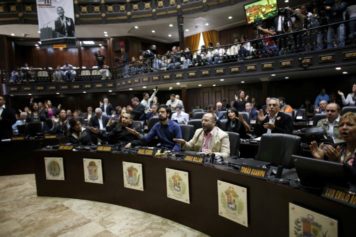
There is no doubt of the military’s influence in Venezuela. Eleven of the 20 states controlled by governors from the United Socialist Party are led by former military officers, while a quarter of the ministers in Maduro’s cabinet, which he inherits from Chávez, came through the military. In addition, according to the New York Times, military figures run dominant state companies like the Venezuelan Guayana Corporation, a conglomerate that operates in gold and aluminum, among other industries.
Chavez critics say that in his efforts to rule Venezuela with a military hand, he allowed generals accused of involvement in drug trafficking without an investigation and even appointing them to important posts.
It is a good sign for Maduro—the former union organizer, legislator and foreign minister—that the top military official in the cabinet, Defense Minister Diego Molero Bellavia, seemed to put his support behind Maduro by calling on voters to “give a good thrashing to all those fascists” of the opposition. Henrique Capriles, the Miranda state governor who lost to Chavez in October, has officially been slated as the opposition candidate in the April election, which is sure to be closely watched around the world. If Maduro is rejected, the West will see it as an opportunity to re-engage with the nation that currently has the world’s largest oil reserves.
But polls indicate that is unlikely to happen. In a poll taken during February, before Chavez’s death, Maduro held a 46.4 percent to 34.3 percent advantage over Capriles. That advantage likely has only increased after Chavez’s death.
Maduro is also keeping a close eye on the nation’s economy, announcing over the weekend to a Chinese delegation led by Zhang Ping, head of the country’s top economic planning agency, that “the best tribute” he can pay to Chavez would be to deepen Venezuela’s strategic alliance with China.
“It would take a miracle for the opposition to overcome such a completely adverse situation,” Leonardo Palacios, a Caracas lawyer who served as an opposition lawmaker alongside Maduro, said in a phone interview.
In a piece in the Boston Globe, commentator James Carroll said the U.S. often makes the mistake, in trying to discredit Chavez as a crazy buffoon, in underestimating how immensely popular he was among Venezuela’s poor for the sincere efforts he made to improve their lives.
Carroll said Chavez can best be understood by a quote attributed to famous Brazilian cleric and liberation theologist: “I bring food to the hungry and they call me a saint. I ask why there are so many hungry, and they call me a communist.”
“The Venezuelan leader began by asking Camara’s question,” Carroll writes. “That is why millions of poor people recognize Chavez as theirs, and why there was so much open grief in the streets of Caracas last week.”