While his popularity has been lagging in France, French president Francois Hollande was welcomed like a conquering hero in Mali after French troops successfully routed Islamist rebels from the major Mali cities and pushed them to the mountains in the northeast.
Hollande surprised the world when he sent more than 2,000 French troops to Mali when the Islamist rebels were advancing on Bamako, the Mali capital. Over the past month, French troops joined the Malian army to retake most of the territory, including the cities of Gao, Timbuktu and Kidal.
On a whirlwind one-day tour, Hollande was greeted by jubilant Malians everywhere he went. Malians danced to the beat of drums, which was banned by the Islamist rebels under sharia law. In the famed city of Timbuktu, where Islamists had destroyed historic mausoleums, Hollande saw sport shirts with the flags of both countries and banners reading “Thank You France.” Hollande was presented with the gift of a camel. He waded into the adoring crowd in Timbuktu, accompanied by French Foreign Minister Laurent Fabius, Defense Minister Jean-Yves Le Drian and Development Minister Pascal Canfin.
“I have just lived through the most important day of my political life,” Hollande said to the cheering crowd waving the French red, white and blue colors and holding portraits of the president.
In Bamako, Hollande said, “Terrorism was pushed back, chased, but it hasn’t yet been vanquished,” Hollande told a jubilant crowd yesterday. “France will stay with you as long as it takes, until the time for Africans themselves to replace us. Until then we will be beside you to the end, as far as north Mali.”
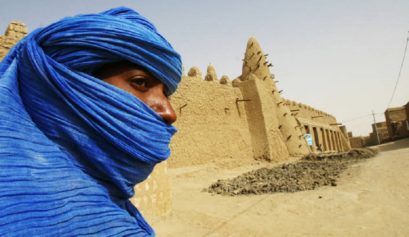
Hollande joined Mali’s interim president, Dioncounda Traore, on a walking tour in Timbuktu, speaking to French troops and visiting the 700-year-old mud mosque of Djingareyber and the Ahmed Baba library of ancient manuscripts.
At the site of the ancient saints’ tombs torn down with pickaxes in July, Hollande said to the mosque’s imam, “There’s a real desire to annihilate. There’s nothing left.”
“We’re going to rebuild them, Mr. President,” said Irina Bokova, the head of UNESCO. Tourism, a major economic engine in Timbuktu, has been wiped out by the conflict in Mali.
“The fight is not over,” Hollande said, as France “has finally given back to Mali its unity, integrity and strength.”
Mali is a former French colony. Hollande said his country would support the Malian economy and help with reconstruction of public services, education, health, security and cultural heritage.
Mali’s spirits were also boosted after Hollande’s visit by the triumph over South Africa by Mali’s national football team in the Africa Cup of Nations. For the first time since 1972, Mali advanced to the continental semi-final.
“This victory… is going to help Mali find peace again,” said Mamadou Traore in the capital’s Same neighborhood as his children jumped with excitement.
As the rebels were routed from the cities, a lingering worry is the persecution and even torture that has been inflicted on light-skinned Malians who are suspected as being supporters of the Islamist rebels, who tended to be lighter in complexion from the north.
Hollande urged Malians to refrain from exacting vengeance against locals who had cooperated with terrorist groups. In a speech, Traore said his people should not resort to “vengeance, hate and settling of accounts.”