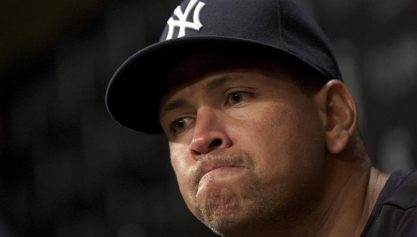
New York Yankees all-star Alex Rodriguez has been mired in baseball’s ongoing performance-enhancing drugs crisis for some time. But now comes perhaps the most damning evidence against him.
On ESPN’s Outside The Lines, intimate details of Rodriguez’s use was laid out, including text messages and exact procedures of how and when the injections took place, according to sources.
Unidentified people close to the situation told the program that Anthony Bosch would receive texts from A-Rod, usually late at night, telling him to come to Rodriguez’s waterfront mansion on Biscayne Bay, Fla., through the gate on North Bay Road, to inject performance-enhancing drugs into the third baseman.
A spokesperson for Rodriguez on Friday said, “the allegations are not true.”
Procedures were different, though, sources told Outside the Lines, for the other athletes who were customers of Bosch’s Biogenesis of America clinic in Coral Gables, which Major League Baseball considers the center of a widespread doping operation in South Florida. Those athletes, sources said, relied on intermediaries to transport the performance-enhancing drug regimens Bosch provided.
But for A-Rod, the service was always personal: “Only Tony handled A-Rod,” one source told Outside the Lines.
According to the sources, the visits took place every few weeks. One night last spring, a source said, Bosch told associates he had been kicked out of Rodriguez’s home after he had trouble locating a vein, infuriating the player.
The sources did not say why Bosch would have been tapping a vein, as HGH and testosterone do not require intravenous injections. But whatever he was doing, “Tony said A-Rod was pissed at him,” a source said. “He said he was bleeding everywhere.”
Several sources, speaking on the condition of anonymity, said Bosch spoke openly about his relationship with the Yankees All-Star, and two sources said that documents they reviewed detailed the drug regimens and schedules Rodriguez received.
MLB officials say they believe Bosch is at the center of the South Florida doping operation and they have urged the U.S. Drug Enforcement Agency to open an investigation. But numerous sources contacted by Outside the Lines say that they have not been interviewed by federal agents or by MLB investigators, and are not aware of any law enforcement effort to seize material from the now-shuttered Biogenesis office or Bosch’s home.
MLB officials have turned over information they collected to the DEA. But sources in Florida said they have seen no indication that an investigation has begun. DEA officials have declined to comment on the existence of a case.
Rodriguez was named in the Miami New Times on Monday, as one of many athletes listed in Biogenesis paperwork. A source told Outside the Lines that Bosch had an aversion to computerized records and wrote all of his records by hand.
The other MLB players named were Melky Cabrera, Bartolo Colon, Nelson Cruz, Yasmani Grandal and Gio Gonzalez.
Bosch called the allegations against him “bull—-” and “all wrong” when reached by Outside the Lines. His attorney, Susy Ribero-Ayala, also released a statement denying the allegations and told Outside the Lines that Bosch wouldn’t be talking “any time very soon.”
One source familiar with Bosch’s operation said Bosch’s office was visited regularly by Juan Carlos Nunez, a man identified this summer as working for Melky Cabrera’s agents, Seth and Sam Levinson of ACES Sports Management.
After Cabrera tested positive, MLB officials said Nunez created a fake website in an attempt to provide an alibi for Cabrera. The Levinsons previously described Nunez as having been a “consultant,” and said they had no knowledge of his activities or his possible connection to performance enhancement drugs.