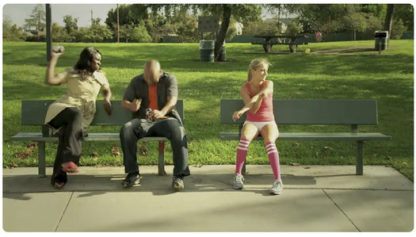
The automaker Volkswagen, known for its creative promotion campaigns, is in the midst of controversy for a Super Bowl television ad that uses the stereotypical voices of happy-go-lucky Jamaicans coming out from the mouths of buttoned-up, conservative-looking corporate white guys —and one Asian guy.
With the “Get Happy” sung by reggae legend Jimmy Cliff playing in the background, the ad is intended to promote the idea that although the economic outlook may be dismal in corporate America, all you need do is hop into a Volkswagen Beetle and all troubles will go away. You’ll be just as trouble-free as the islanders that tourists see in the Caribbean.
Volkswagen and its advertising agency, Deutsch LA, is defending the ad by pointing out that they consulted 100 Jamaicans and retained a speech coach to ensure the authenticity of the accent before going forward with the ad. Volkswagen America’s marketing officer Tim Mahoney said they even collaborated with Cliff himself.
“We’ve taken someone that, I think, is just an amazing legend in music,” Mahoney told CNN. “And then on top of it, we’ve tapped a bit into the popular culture with The Partridge Family song ‘Come On, Get Happy.’”
But that wasn’t enough to mollify writer Christopher John Farley, who wrote a column in The Wall Street Journal criticizing the ad — after his appearance on CNN, during which he was also critical. The New York Times columnist Charles Blow was also on CNN, calling the ad “like blackface with different voices.”
“Cliff is great, but it’s off-putting to see the Island spirit used as a punchline,” Farley wrote on WSJ.com. “The Jamaican aesthetic–shaped by such Jamaican-born notables as Bob Marley, Marcus Garvey and the revolutionary Nanny of the Maroons – is founded on positive vibration, not mindless happiness.”
Farley said the ad, which Volkswagen was previewing before its expected airing during the Super Bowl, might be the 2013 equivalent of the Star Wars Jar Jar Blinks controversy. The movie franchise was criticized for having an alien in the second trilogy speak a strangely broken English that sounded to many like a strange form of Ebonics. As Farley pointed out, “Instead of laughing, some viewers were outraged.”